
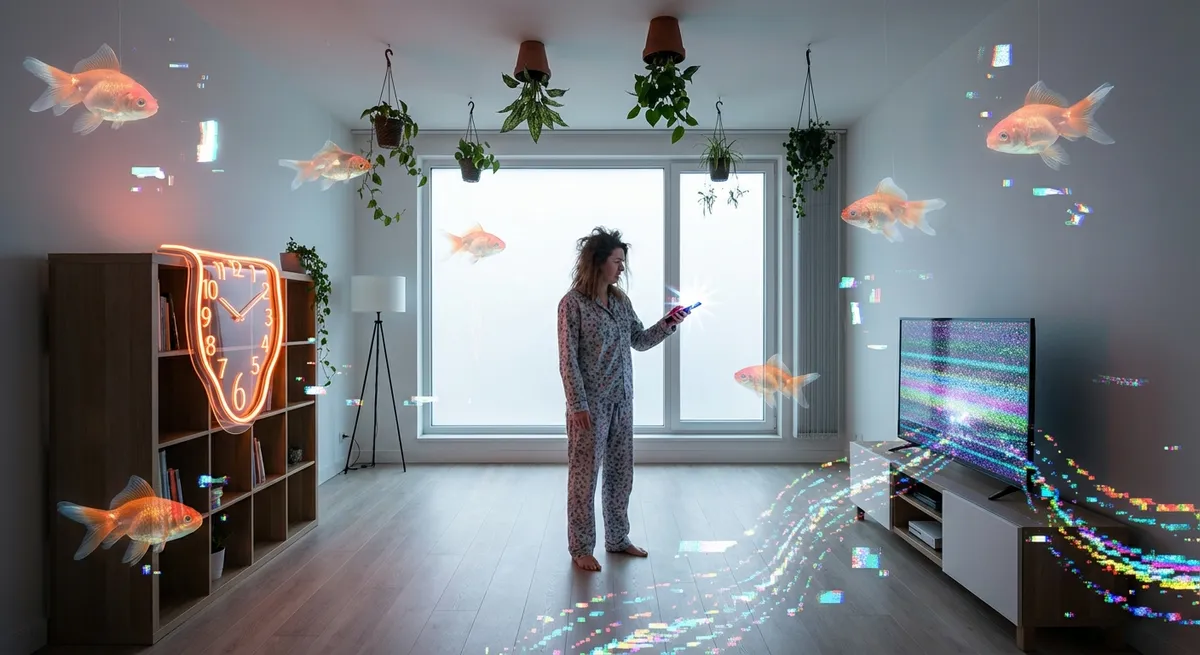
Ever get the feeling the universe is running on a janky beta version of reality? Same. Today we’re diving into weird facts so chaotic they feel like a cosmic intern accidentally clicked “apply to all” in the settings menu.
These are the kinds of facts that make you pause, re-read, then immediately send to three friends with “WHY DID I NOT KNOW THIS.”
Let the glitch tour begin.
The Banana You Know Is Basically a Clone Army
That banana in your kitchen? It’s not just a fruit. It’s a copy of a copy of a copy of a copy. Almost every supermarket banana on Earth is the same variety—the Cavendish—and they’re all clones.
No, seriously. They reproduce asexually, so genetically they’re basically Ctrl+C, Ctrl+V. This is efficient for farming, but it also means if one nasty disease figures out how to kill a Cavendish banana, it can theoretically wipe out almost all of them. This already happened once to a previous favorite banana, the Gros Michel, which was knocked out by a fungus in the mid-1900s like it owed it money.
So your banana isn’t just a snack—it’s a fragile member of a doomed fruit army that exists because we like consistent flavor and easy peeling. Enjoy that smoothie with a side of existential dread.
There’s a Jellyfish That Hits Undo on Aging
Human aging: wrinkles, back pain, mysterious noises every time you stand up.
Jellyfish aging: “Nah, I’m just gonna go backwards now.”
Meet Turritopsis dohrnii, commonly known as the “immortal jellyfish.” When it gets stressed, injured, or old, it can revert its cells back to an earlier stage—basically going from “adult” back to “jellyfish baby mode” and starting its life cycle again. Imagine getting old, hitting 80, and your cells collectively decide, “This timeline sucks, let’s reboot.”
It’s not truly immortal in the “can’t ever die” way—it can still be eaten or wiped out by disease—but biologically, it has the power to reverse aging, which is rude and unfair to everyone with a skincare routine and a receipts-long history at Sephora.
Scientists are actually studying how it does this, because if anything on Earth has secrets worth stealing, it’s the underwater blob that said “no” to the concept of time.
There’s a Planet Where It Literally Rains Glass Sideways
If Earth feels chaotic, just know that somewhere out there is a planet having a much worse day.
Enter exoplanet HD 189733b, also known as “you do not want to live here.” This planet has winds blowing at around 4,000–5,400 miles per hour (yes, thousands), and scientists think it may rain molten glass. Sideways. At supersonic speed.
So imagine a never-ending hurricane that pelts you with razor glass at speeds that would make a fighter jet cry. Meanwhile on Earth we’re like, “Ugh, it drizzled and my Wi-Fi got weird.”
Also, this planet is a deep, intense blue. But unlike our peaceful blue oceans, its color likely comes from its wild, scorching atmosphere. It looks like a desktop wallpaper. It behaves like an unskippable boss fight.
10/10 a great place to point to whenever someone says, “It could always be worse.”
You’re Part Mushroom: The Air You Breathe is Full of Fungal Spores
Take a deep breath.
Congratulations, you just inhaled a tiny puff of fungus.
The air around you is full of microscopic fungal spores, drifting like invisible confetti. Scientists estimate that billions of tons of fungal spores get launched into the air every year. They’re on your clothes, in your house, and riding every gust of wind like they paid for business class.
Before you start Lysol-ing your soul, calm down: fungi are a normal part of our environment and many are harmless or even helpful. They help recycle dead stuff, support plant life, and give us essential things like bread, beer, cheese, and multiple extremely questionable kombucha experiments.
But the wild part is how much fungal material is just constantly floating around in the air we share. At any given moment, a chunk of “you” is technically built from molecules that once belonged to fungi, because the planet is basically running a never-ending recycling program. You’re not just human—you’re a collaborative group project with mushrooms.
Octopus Brains Are So Weird We Basically Have No Idea What It Feels Like to Be One
If aliens ever visit, they’re probably going to look at humans and go, “Whoa, are those land-octopus knockoffs?”
Octopuses have about 500 million neurons—similar to a dog—but here’s the twist: a huge chunk of those neurons are in their arms, not just their central brain. Each arm can act semi-independently, “deciding” what to do while still being part of the whole animal. It’s like if your left hand could ignore your brain and go start a side hustle.
They can solve puzzles, escape from tanks, open jars, rearrange aquariums, and in some documented cases, quietly sabotage equipment they don’t like. Some are known to recognize individual humans and throw jets of water at certain people. That’s not random behavior. That is specific, targeted pettiness.
The real mind-melter? Their intelligence evolved completely separately from ours. They’re the closest thing we have to a totally different style of thinking creature on Earth—like an experimental DLC for “consciousness” that the universe snuck into the ocean.
Conclusion
The universe didn’t just make life; it speed-ran weirdness.
We’ve got clone armies of bananas, jellyfish that dunk on aging, glass-rain planets, accidental mushroom inhalation, and hyper-intelligent ocean noodles with freelance arms. And this is just what we know so far.
So next time life feels boring, remember: you live on a ball of rock hurtling through space, partially made of mushrooms, eating cloned fruit, while a jellyfish somewhere is hitting the “undo” button on getting old.
Go ahead—send this to someone who thinks reality is “normal.”
Sources
- FAO: Banana Market Review - UN Food and Agriculture Organization report on global banana production and dependence on Cavendish variety
- Smithsonian Magazine: The Secret of Immortal Jellyfish - Overview of Turritopsis dohrnii and its ability to revert its life cycle
- NASA: Hubble Observations of Exoplanet HD 189733b - NASA summary of the extreme conditions and blue color of exoplanet HD 189733b
- USDA Forest Service: Fungal Spores in the Atmosphere - Research on atmospheric fungal spores and their abundance
- Scientific American: How Smart Are Octopuses? - Explores octopus intelligence, neuron distribution, and complex behavior