
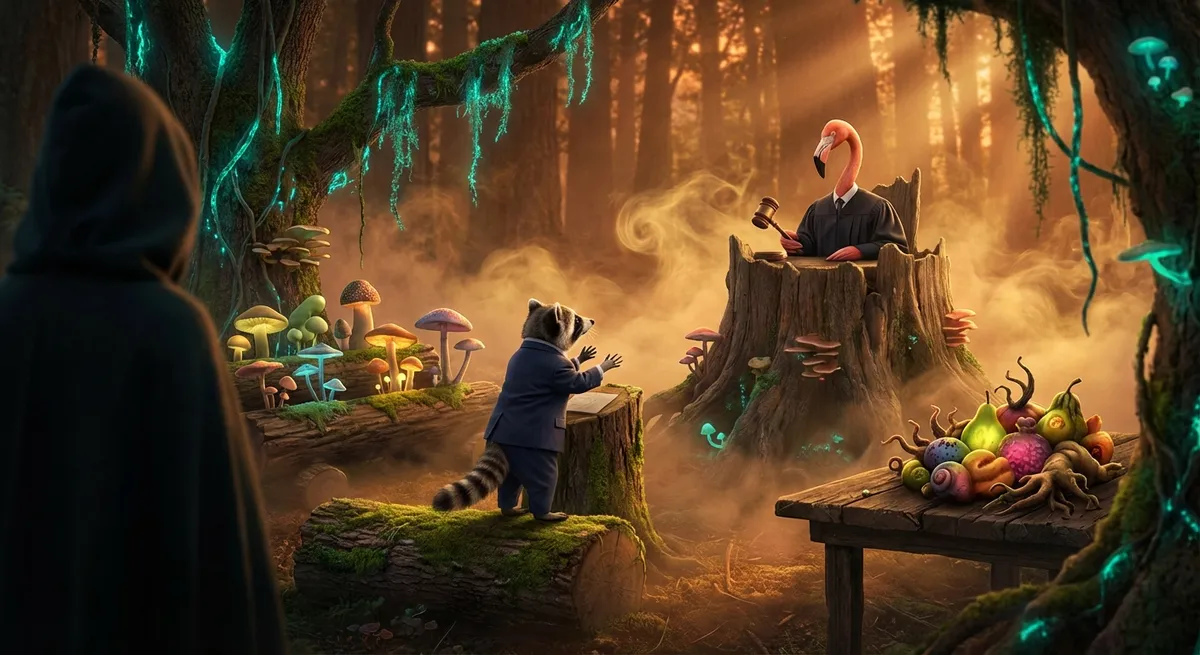
Somewhere between “the ocean is deep” and “space is big,” reality just gave up and went full chaos mode. Nature is basically that one friend who says, “Trust me, it’ll be fun,” and suddenly you’re learning that mushrooms talk, octopuses jailbreak, and a parasite is out here speed‑running mind control like it’s a side hustle.
Welcome to the Bored Monkee briefing on stuff that definitely sounds fake but isn’t. Screenshot these. Send them to your group chat. Ruin someone’s peaceful day with knowledge.
The Mushroom Internet Is Real And It’s Judging You
Deep under forests, trees are secretly using mushrooms like Wi‑Fi routers.
There’s a vast underground network of fungal threads called mycorrhizae that connect the roots of different plants. Scientists literally call it the “wood wide web” because nutrients and chemical messages travel through it like status updates. Trees use this network to share resources, warn neighbors about pests, and sometimes even sabotage competitors by cutting them off like toxic exes.
Older “mother trees” can funnel extra nutrients to younger ones, which is adorable and also suspiciously wholesome. Some plants even “pay” fungi with sugar to get better access to water and minerals, which means there is a functioning economy beneath your feet and none of us are being compensated for walking on it.
Next time you trip over a tree root, just know you basically stubbed your toe on a forest group chat.
There’s A Parasite Out There Cosplaying As A Mind-Control DLC
If you thought zombies were just for movies, the parasite Toxoplasma gondii would like a word.
This microscopic chaos goblin normally lives in cats, but it can infect other animals (and humans) too. In rodents, it pulls the ultimate horror plot twist: it can mess with their brains so they stop fearing cat smells. Imagine being a mouse and suddenly thinking, “Wow, cat pee? Smells like opportunity.”
This makes the mouse more likely to get eaten by a cat, which is exactly what the parasite wants so it can complete its life cycle. That’s not evolution—that’s a villain origin story.
Humans can get infected too (usually through undercooked meat, soil, or cat litter), and while most healthy people don’t feel anything, some research suggests it might slightly influence behavior and risk‑taking. So somewhere out there, a parasite might be low‑key tweaking people’s life choices, and we’re just scrolling past it.
You’re not the main character. The parasite is.
Octopuses Are Out Here Speedrunning “Great Escape” IRL
Octopuses have decided the rules do not apply to them.
They have no bones, three hearts, blue blood, and more neurons in their arms than many animals have in their entire bodies. Each arm can basically freestyle decisions like it’s an independent roommate. In labs and aquariums, octopuses have been caught opening screw‑top jars, unscrewing pipes, turning off lights, and escaping their tanks just to snack on nearby fish and then sliding back like nothing happened.
Some have learned to recognize specific humans (and squirt water at the ones they don’t like, which is relatable). Others use coconut shells or empty bottles as armor and portable hideouts, because apparently tool‑use wasn’t exclusive enough already.
We’re out here forgetting why we opened the fridge, while octopuses are running full stealth missions like eight-armed super spies.
Your Bones Are Quietly Glowing Like Discount Nightlights
Your skeleton is not just a creepy Halloween prop — it literally glows under UV light.
Researchers discovered that bones and teeth naturally fluoresce thanks to certain proteins and minerals. Shine ultraviolet light on a skeleton and it can glow blue, green, or other colors depending on age, composition, and condition. Forensic scientists actually use this in crime scenes to help find tiny bone fragments.
Some animals turn the glow game up to 11. Certain frogs, chameleons, and even flying squirrels have bones or body parts that glow under UV, which may help with communication or camouflage. So while you’re out here buying LED lights for the vibe, nature already installed a built‑in rave pack in your skeleton before you were born.
Congratulations: you’re accidentally luminous.
Space Is Leaking Time In The Rudest Possible Way
You are currently traveling through time at one second per second, but not everyone is moving at the same speed.
Thanks to Einstein and his whole “reality is bendy” situation, time passes differently depending on speed and gravity. Clocks on GPS satellites tick slightly faster than clocks on Earth because they’re farther from the planet’s gravity. Scientists actually have to correct for this, or your navigation app would be wildly wrong and you’d be lost in a Walmart parking lot forever.
Even on Earth, highly precise atomic clocks at different altitudes tick at slightly different rates. Time moves just a tiny bit faster in a plane than at sea level. That means if you live in a skyscraper, your head is technically older than your feet by an almost hilariously small amount.
So yes, time is real, but also kind of not, and your phone is using general relativity just so you can find the nearest taco place.
Conclusion
Reality is out here doing side quests nobody asked for: mushrooms running underground Wi‑Fi, parasites unlocking brain hacks, octopuses planning prison breaks, your bones glowing like secret rave gear, and time itself operating on “it’s complicated” mode.
If your life feels weird, that’s not a bug. That’s the default setting of the universe.
Now go send this to someone who still thinks “nature is peaceful” and watch their worldview reboot.
Sources
- [Smithsonian Magazine – The “Wood Wide Web”](https://www.smithsonianmag.com/science-nature/the-whispering-trees-180968084/) - Explains how trees use fungal networks to share resources and information
- [CDC – Toxoplasmosis](https://www.cdc.gov/parasites/toxoplasmosis/index.html) - Overview of the Toxoplasma gondii parasite, transmission, and effects
- [Scientific American – The Mind of the Octopus](https://www.scientificamerican.com/article/the-mind-of-an-octopus/) - Describes octopus intelligence, problem-solving, and escape behavior
- [National Institutes of Health – Bone and UV Fluorescence](https://www.ncbi.nlm.nih.gov/pmc/articles/PMC5452526/) - Research article discussing bone fluorescence under ultraviolet light
- [NASA – General Relativity and GPS](https://www.nasa.gov/feature/goddard/2016/general-relativity-and-gps-how-einstein-s-theories-make-modern-navigation-possible) - Explains how time dilation affects GPS satellites and why relativistic corrections are needed