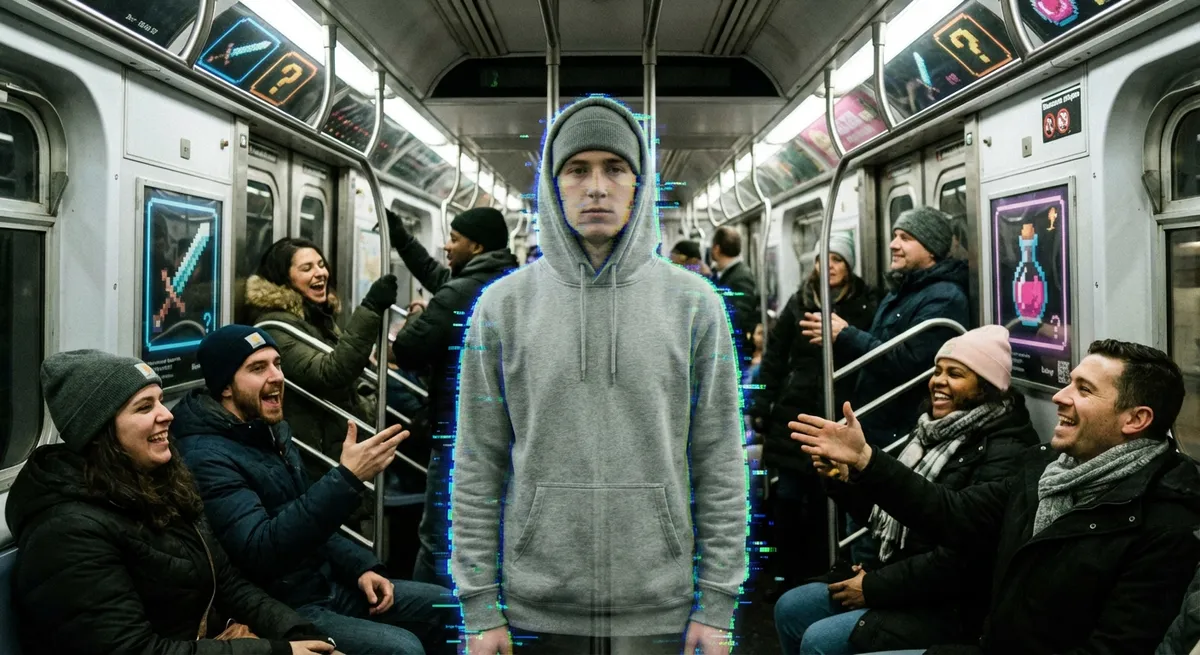
At least once a week, your brain whispers: “Are we… the main character or just that guy in the back holding a plastic bag?” If you’ve ever replayed a conversation from three days ago while staring at the ceiling fan like it’s loading the next cutscene, congratulations: you might be experiencing NPC Energy. No, you’re not actually an AI‑generated villager living in someone else’s open-world game… probably. But your daily glitches, awkward dialogue, and weird side habits are extremely shareable, deeply relatable, and honestly? Hilarious.
Let’s speedrun the strange comfort of realizing everyone else is just as bugged as you are.
That Weird Lag Before You Answer “How Are You?”
You know that split-second pause when someone asks “How are you?” and your brain blue-screens before auto-replying, “Good! You?” even if you are, in fact, a flaming trash can with wi-fi?
That’s NPC dialogue. You’ve unlocked the default script.
You probably have about five pre-programmed lines you recycle on loop:
- “Can’t complain!” (You absolutely can and will, later.)
- “Just tired.” (You’ve been “just tired” since 2014.)
- “Living the dream.” (Nightmare DLC included.)
Humans do this because our brains like shortcuts—social scripts smooth out interactions so you don’t have to improvise every time someone walks by and says “Hey.” That tiny lag you feel? It’s your brain scrolling through the dialogue wheel like, “Loading… loading… okay, pick the least weird one.”
The funny part: everyone else thinks you seem normal and they’re the glitchy one. Which means we’re all NPCs to somebody. That’s kind of beautiful. And broken. Beauti-broken.
Main Character Moments That Would Definitely Be Cut In Editing
In your head, you’re mysterious, complex, and cinematic. In reality, your “movie moments” look like:
- Putting headphones in with no music playing so you don’t have to talk to anyone.
- Dramatically staring out a window, then realizing you’re just watching a pigeon bully a sandwich.
- Power-walking to a beat in your head that is definitely not playing out loud.
- Pausing your music to rewatch a fight you’re having entirely in your imagination.
If your life had a director, half your “serious scenes” would get deleted for pacing. No one needs a 14-minute sequence of you trying to find the “right” angle before turning your camera on for Zoom.
But here’s the twist: this is what makes you aggressively shareable. Everyone has these private, unhinged little movie clips in their day that feel too specific. When you call them out, people share it with “WHY IS THIS SO ME??” and suddenly your weird is universal.
Your life might not be a neatly written Netflix show, but it is absolutely a chaotic improv with no budget and incredible meme potential.
The Side Quest Spiral (a.k.a. Why You Opened The Fridge 7 Times)
Your day starts simple: “I will do One Main Task.”
Five minutes later, you’ve accidentally:
- Opened the fridge to “check something” with no idea what you’re checking.
- Picked up your phone to set a timer and instead read 12 comments on a stranger’s argument.
- Sat down to answer one email and ended up deep-diving the history of fonts.
- Carried something into another room, forgot why, and just… put it down like a confused courier.
This is side quest energy. Your brain loves little dopamine snacks, so it keeps offering optional mini-missions like: “Refill water bottle,” “Rearrange one (1) shelf,” or “Google ‘do cats know I’m ugly crying.’”
Ironically, side quests are how games keep you hooked—and how real life makes you feel like you did nothing even when your activity log is insane. You didn’t “waste the day.” You completed:
- 3 Cleaning Missions (Partial)
- 1 Social Interaction (Survived)
- 27 Thought Spirals (Legendary Tier)
When you share your most ridiculous “how did I end up here?” side quest story, you’re basically holding up a mirror to everyone else’s brain. Which is why people tag their friends with “THIS IS YOU” and start a whole thread of accidental adventures.
Glitch Moments Your Brain Pretends Didn’t Happen
At some point recently, you have:
- Said “You too” to a waiter who wished you “Enjoy your meal.”
- Walked in the wrong direction, realized it, and immediately pulled out your phone like “Ah yes, my GPS demands a U-turn.”
- Tried to push a pull door with full emotional commitment.
- Laughed at something, then had to ask, “…wait, what did they say?”
These are human glitches. Tiny system errors. And your brain has a dedicated department called Embarrassment Archives that replays them at 3 a.m. in 4K quality for no reason.
Here’s the fun part: when you post these moments, everyone else hits share because embarrassment is so collective. One study on social blunders and cringe actually suggests that we’re wired to detect awkwardness in others and bond over it—cringe is basically an emotional group chat.
So the next time your tongue forgets how words work or you wave back at someone who was actually waving at the person behind you, just remember: you’ve created free comedy content for someone’s internal highlight reel.
The Background Character Mindset That Weirdly Sets You Free
There’s something low-key magical about leaning into NPC Energy on purpose.
When you stop trying to be the lead in every room, a few things happen:
- You care 60% less about looking “cool” and 300% more about being comfortable.
- You start doing goofy little things (talking to yourself in the aisle, bad dancing, wearing That One Outfit) because nobody’s watching you like a live stream.
- Social situations feel less like auditions and more like sandbox mode.
- You realize everyone else is too busy worrying about their own face to care what yours is doing.
Psychologists call part of this the spotlight effect: your brain thinks people notice you way more than they actually do. Once you realize you are, in fact, just one extra in most people’s day, you unlock elite freedom. You can be cringe. You can be weird. You can be that person mouthing song lyrics dramatically at a red light.
When you talk about this mindset shift online, it spreads because it’s both funny and secretly healing. “We’re all background characters in each other’s stories” sounds like a meme, but it’s also a permission slip: live like no one’s screenshotting.
Conclusion
You are not a perfect protagonist with flawless dialogue, seamless plot arcs, and cinematic lighting. You’re a slightly buggy, extremely relatable, occasionally laggy human running on caffeine, Wi‑Fi, and intrusive thoughts.
Your NPC Energy—the awkward scripts, the glitch moments, the weird side quests—is exactly what makes you worth watching and, more importantly, worth sharing. Because underneath the jokes is this quiet truth: nobody actually knows what they’re doing. We’re all just mashing buttons and hoping for the good ending.
So go forth. Forget what you were about to say mid-sentence. Wave at someone who wasn’t waving at you. Open the fridge again. Then tell the internet about it.
Someone out there is going to read it and think, “Wait… I thought that was just me.”
Sources
- [American Psychological Association – The Spotlight Effect](https://www.apa.org/monitor/jun03/spotlight) – Explains why we think people notice us more than they actually do
- [Greater Good Science Center (UC Berkeley) – Why We Cringe at Ourselves](https://greatergood.berkeley.edu/article/item/why_we_cringe_at_ourselves) – Looks at the psychology behind awkwardness and self-consciousness
- [Harvard Business Review – Why You Feel Like an Impostor](https://hbr.org/2008/05/overcoming-imposter-syndrome) – Discusses impostor feelings and why we doubt our “main character” status
- [Verywell Mind – Social Scripts and How They Work](https://www.verywellmind.com/what-are-social-scripts-5197442) – Breaks down those automatic phrases we use in everyday conversations
- [Cleveland Clinic – Dopamine and Your Brain](https://health.clevelandclinic.org/dopamine) – Explains the brain’s reward system and why we chase little “side quest” rewards