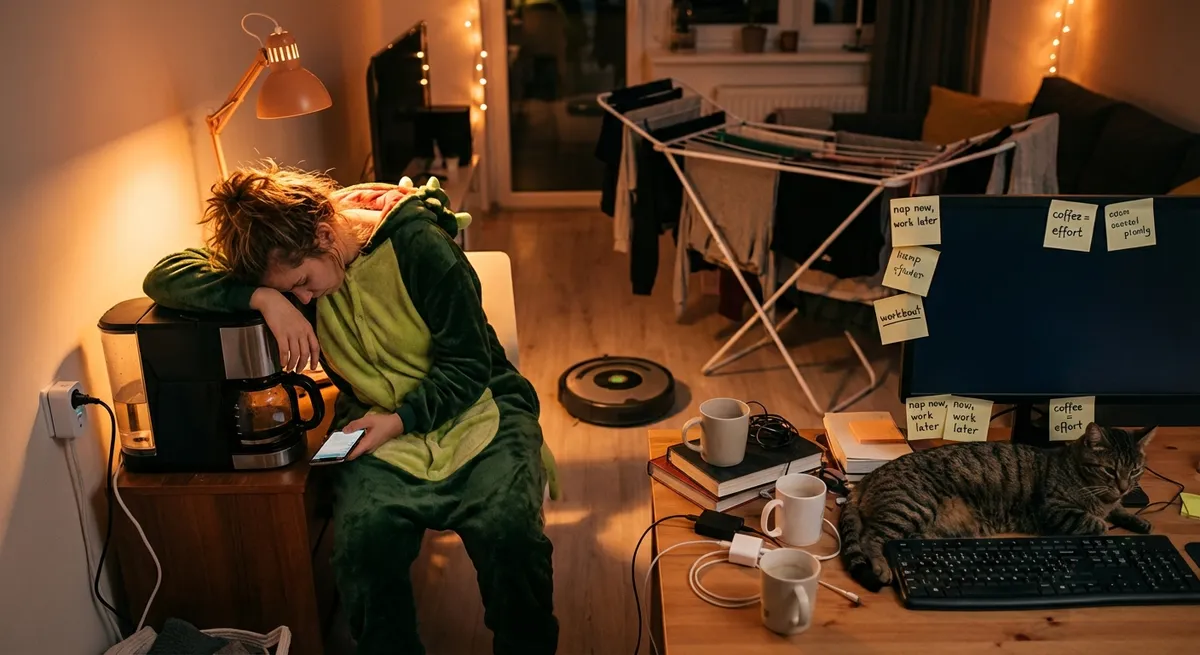
You know those hyper-productive people who wake up at 5 a.m., make a smoothie, run a marathon, and answer 48 emails before you’ve even remembered your own name?
This article is not for them.
This is for the rest of us: the chronically tired, easily overwhelmed, semi-responsible goblins just trying to make life 10% easier without turning into a Pinterest board.
Below are five low-effort, high-chaos-but-it-works life hacks you can actually use in real life, not just in inspirational Instagram reels narrated by someone who owns three blenders.
The “Future Me Is Useless” System
Let’s be honest: “future you” is not a better person. Future you is the same gremlin, just wearing different socks and slightly more exhausted. So stop relying on them.
Instead, build your life around the assumption that future you will forget, bail, or get distracted by a pigeon.
How to do it:
- Default everything. Set bills to auto-pay, subscriptions to auto-cancel reminders, and online carts to auto-empty after 24 hours. Fewer decisions = fewer chances for future you to mess it up.
- Put stuff where you trip over it. Don’t neatly place your gym bag in a closet like you’re in a Nike commercial. Drop it right in front of your bedroom door so you literally have to step over your own promises.
- Use “when, not if” reminders. Instead of “remember to call the dentist,” write “When you open TikTok again, call the dentist first.” No moral judgment, just accurate psychology.
- Make the action stupidly small. “Do taxes” becomes “Open the tax folder.” That’s it. You’ve tricked your brain into starting. Starting is usually the worst part anyway.
Why it works: your brain is lazy, but it’s also obedient to whatever is easiest. Make the “right” thing physically and mentally easier than the “forget it” option.
Turn Your Kitchen Into a Lazy Vending Machine
You are not failing at cooking. You are failing at being a 24/7 personal chef for yourself while also pretending to be a functioning adult. Different problem.
So instead of “meal prepping like a fitness influencer,” turn your kitchen into a vending machine where all the buttons are at least half-decent for you.
How to do it:
- Prep ingredients, not meals. Chop a whole bunch of stuff once: onions, cucumbers, peppers, fruit, etc. Put them in clear containers. Now Past You is your unpaid sous-chef.
- Clear containers only. If you can’t see it, your brain will act like it doesn’t exist. Transparent boxes = “Oh wow I do have strawberries instead of despair.”
- Use “one-bowl laws.” Any recipe that uses more than one pan/bowl/tool is illegal Monday–Friday. Stir-fry in one pan, salads in one bowl, sheet pan dinners. Less cleanup = more chance you’ll actually cook.
- Snack architecture. Put healthier snacks at eye level and chaos snacks slightly out of reach. You’re not banning chips. You’re just making the apple say “hi” first.
Why it works: humans are extremely suggestible raccoons. Whatever is easiest to grab usually wins. So rig the snack game in your favor without pretending you’ll start juicing kale at sunrise.
Social Battery Protection Program (SBPP)
You know that moment when you agree to plans and instantly feel future regret pulsing behind your eyes? Time to install a Social Battery Protection Program.
You’re not antisocial—you’re just running on 12% battery and no charger.
How to do it:
- Use the “soft yes.” Instead of committing immediately, say: “That sounds fun! Can I confirm the day before? My week’s a bit chaotic.”
- Pre-decide your monthly social limit. Example: “I have three ‘going out’ tokens per month.” Once you’ve used them—congrats, you’re “booked.” Even if your plan is staying home googling “why am I like this.”
- Make “leaving early” a feature, not a failure. Tell friends upfront: “I can come but I turn into a pumpkin around 10.” Then when you dip at 10:01, you’re not bailing—you’re following the lore.
- Use scripts for saying no.
- “I’m at capacity this week, but thank you for thinking of me.”
- “That does sound fun, but I really need a low-key weekend to reset.”
You’ve just given future you an emergency exit.
You’re not lying. You are at capacity. Emotionally, spiritually, energetically, all of it.
Why it works: protecting your energy isn’t selfish. It’s how you make sure that when you do show up, you’re an actual person and not a sentient husk clutching a drink.
Weaponize Boredom Against Bad Habits
Your phone thinks it owns you. And to be fair, it kind of does. But you can hack your goblin brain with a trick: don’t fight your habits head-on—make them boring.
You’re not trying to become a monk; you’re just trying to make doomscrolling less shiny.
How to do it:
- Grayscale mode = chaos killer. Switch your phone screen to black & white. Suddenly your feed looks like a sad documentary, and your brain gets bored faster.
- Barrier, not ban. Instead of deleting social apps, bury them in a folder three swipes deep with a name like “Are You Sure.” That one extra second can break the autopilot.
- Make a “boredom board.” Keep a short list in your notes app called “Things to do instead of scrolling”:
- make iced tea
- stretch for 3 minutes
- read 2 pages of a book
- text one friend something weird but wholesome
- Change the trigger location. If you always scroll in bed, make your bed a no-phone zone and move scrolling to the couch. Boring but effective: your brain associates spaces with behaviors.
Reach for that list before you open another app.
Why it works: research on habit formation shows that messing with the cue (trigger) or the reward is more effective than yelling at yourself to “have more discipline.” You’re not a villain; you’re just a slightly programmable raccoon.
The 60-Second “My Life Is Slightly Less On Fire” Reset
You do not need a full life overhaul. You need tiny moments where you feel 5% less chaotic so your brain stops screaming.
Enter: the 60-second reset. One minute. No candles. No crystal. No $80 journal. Just micro-order in the middle of the mess.
Quick resets you can steal:
- The Floor Clear: Set a 60-second timer. Pick up everything on the floor in one room and dump it on a chair, bed, or basket. The room looks 70% less cursed and you can sort it later (or never; that’s between you and the chair).
- The Surface Swipe: Choose one surface (desk, nightstand, coffee table). Clear trash, dishes, random mail. One tiny island of sanity. Your eyes will silently thank you.
- The Inbox Mercy Rule: Open email. Delete or archive anything older than 30 days that you know you’ll never answer. If it was urgent, they already found another victim.
- The Clothes Decision Amnesty: If it doesn’t fit, is broken, or feels like emotional baggage, it goes into a bag marked “Not My Problem Anymore” for donation. Don’t overthink. Yeet with love.
Why it works: your brain is constantly scanning for visual chaos. Tiny resets lower the background noise, which makes everything else feel less impossible. You’re not fixing your life—you’re just turning down the static.
Conclusion
You don’t need to become a brand-new person to make life feel lighter. You just need to assume:
Future you is unreliable
Your brain will pick the easiest option
You are, in fact, a slightly dramatic raccoon in a human suit
So you rig the game:
- Make good choices the default
- Make bad habits mildly annoying
- Protect your energy like it’s a rare Pokémon
- Let tiny resets stop the “everything is on fire” feeling before it spirals
None of this will make you a perfect human. But it will make you a little more functional, a little less frazzled, and a lot more likely to send this to a friend with the caption: “This is aggressively me.”
And honestly? That’s more than enough.
Sources
- [UCLA Health – Why automating decisions reduces stress](https://www.uclahealth.org/news/article/decision-fatigue-what-it-is-and-how-to-overcome-it) - Explains decision fatigue and how minimizing choices helps mental energy
- [Harvard Business Review – How to Build Better Habits](https://hbr.org/2021/02/5-strategies-for-forming-better-habits) - Breaks down practical strategies for designing habits that actually stick
- [NPR – Screen time and grayscale phone trick](https://www.npr.org/sections/health-shots/2019/12/30/792011377/tips-to-help-you-cut-back-on-screen-time-in-2020) - Discusses using grayscale and other techniques to reduce addictive phone use
- [Mayo Clinic – Social isolation, burnout, and setting boundaries](https://www.mayoclinic.org/healthy-lifestyle/adult-health/in-depth/burnout/art-20046642) - Covers burnout, emotional exhaustion, and the importance of boundaries
- [University of Minnesota – The impact of clutter on stress](https://www.takingcharge.csh.umn.edu/how-does-clutter-affect-your-brain-and-body) - Explores how clutter affects the brain and why tidying small areas can reduce stress