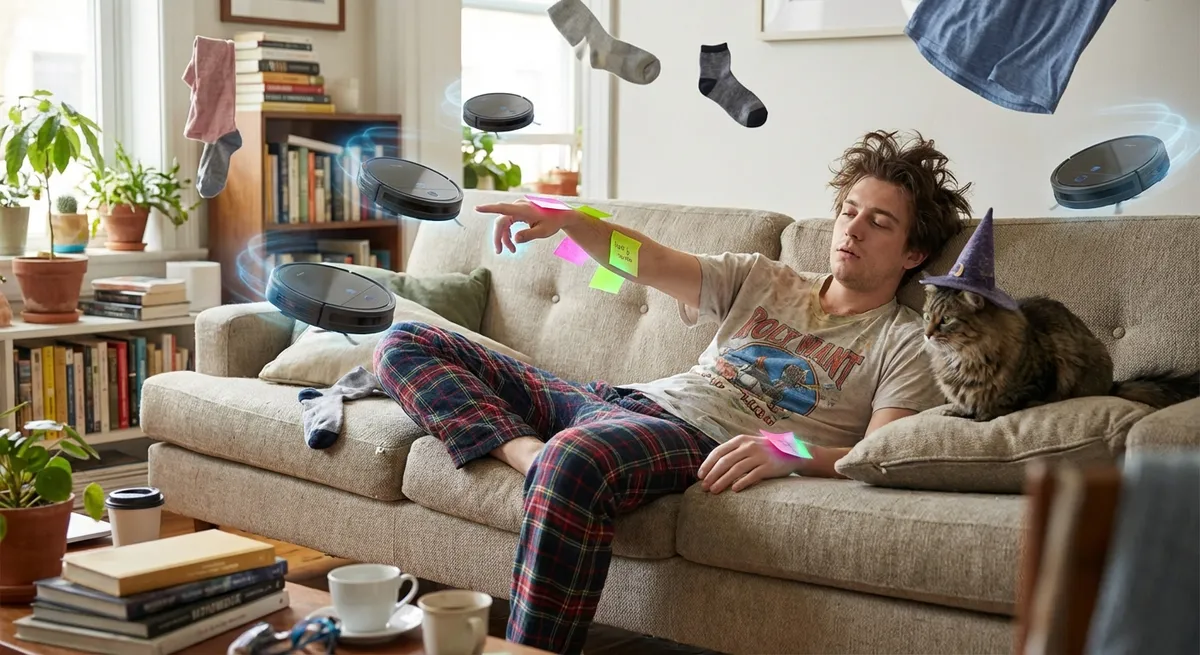
You don’t want to “optimize your potential.” You want to stop losing your phone while you’re on a call with it. This is a safe space.
Welcome to the lazy person’s guide to looking weirdly competent with the absolute minimum amount of effort. These are the kinds of life hacks that make friends say, “Wait. That’s actually genius.” and then immediately steal them.
The “Future You Is a Goblin” System
Here’s a harsh truth: Future You cannot be trusted. Future You is the same person who thought, “I’ll just watch one episode.” You must assume Future You is a chaos raccoon and design life around that.
Instead of relying on motivation, build what I call “idiot-proof autopilot.” Put the things you want to do in the path of the things you’re already going to do anyway. Want to drink more water? Put a full bottle in front of your coffee maker, so you literally have to move it to make caffeine. Want to remember vitamins? Hide the vitamin bottle in your cereal bowl at night so Future You can’t pour breakfast without discovering your little health booby trap.
The trick is to turn good decisions into the easiest, laziest option. Put your workout clothes between your bed and your bathroom, so you literally trip over them. Put your book on your pillow when you make the bed so “I forgot to read” becomes “I physically threw my book on the floor to open TikTok.” It’s not about willpower; it’s about quietly making the right thing slightly less annoying than the wrong thing.
Share appeal: Everyone is currently at war with Future Them. This makes it feel funny and fixable instead of like a personal failure.
The “One Tiny Upgrade” Rule That Makes You Look Weirdly Fancy
There is a cheat code to looking like you have your life together: upgrade one thing in each category of your life and leave everything else mildly tragic.
Example:
- Your kitchen? Still chaos. But your knife is incredible, and suddenly you chop like a cooking show contestant.
- Your wardrobe? T-shirts from 2017. But you own one great jacket that makes every outfit look like “intentional streetwear” and not “laundry was too hard.”
- Your workspace? Cable spaghetti. But you have one really good lamp, and boom—instant Pinterest mood.
Pick one item per area: sleep (pillow), cooking (knife or pan), daily carry (bag or wallet), appearance (shoes or jacket), digital life (password manager or cloud storage). Upgrade only that to something actually good. Your brain will generalize the upgrade and start treating the whole area as fancier than it is. You’ll feel 23% more put-together with approximately 4% effort.
Bonus: people will assume the rest of your life is at that level. They see the nice jacket and just mentally fill in, “Probably folds their laundry immediately.” They are wrong, but we do not correct them.
Share appeal: Makes people feel like they can “glow up” on a dollar-menu budget. Instant “I could do that” energy.
The “Lazy Person’s Momentum Trick” (The 3-Minute Fake-Out)
Your brain hates starting things, not doing them. So you lie to it. Respectfully.
Pick the task you’re avoiding—dishes, emails, that cursed pile of laundry that’s now a furniture piece—and tell yourself you will do three minutes. Not “start.” Not “be productive.” Just “three minutes of doing it badly.” You are explicitly allowed to half-commit. You can fold clothes wrong. You can reply to emails with “Got it, thanks.” in full lowercase. This is a judgment-free productivity crime zone.
Once you start, momentum kicks in. This is an actual psychological thing: behavior often leads mood, not the other way around. You don’t wait to feel motivated; you start, then motivation follows like a confused duckling. Most of the time, three minutes becomes 15 without you noticing. On the rare day it doesn’t? You still did something, and Past You is now slightly less of a burden.
Upgrade level: Make a 3-minute playlist (legally: 1–2 short songs) and use it as your “bare-minimum soundtrack.” When the music stops, you can quit with a clear conscience—or ride the momentum if it magically appeared.
Share appeal: It’s secretly based on behavioral science but presented like a lie we all agree to tell our brains together.
Turning Your Phone into a Friendly Bouncer (Not Your Overlord)
Your phone is currently a hyperactive raccoon dragging your attention into a dumpster. Time to demote it to a mildly helpful security guard.
Step 1: Move your worst apps off your home screen. No more Instagram/TikTok/Twitter icon at thumb-level. Put them two swipes away in a folder called “Later” or “Chaos.” You’re not deleting pleasure; you’re just making it ever-so-slightly annoying to reach. That tiny friction is surprisingly powerful.
Step 2: Turn off all notifications that are not:
- Messages from humans you actually like
- Actual money things (bank, payment apps)
- Time-sensitive things (rides, deliveries, work emergencies)
Everything else? Email badges, random app alerts, “check out what you missed”—off. If it wouldn’t be allowed to walk into your house screaming every 10 minutes, it does not deserve a push notification.
Step 3: Set one “doom scroll window” per day. Example: 20 minutes after dinner. The rest of the time, treat social apps like dessert, not oxygen. You’re not banning distraction; you’re scheduling it. Oddly enough, when your phone gets quieter, your brain does too—and you regain tiny pockets of focus that feel suspiciously like… peace?
Share appeal: Everyone’s exhausted by their phone, but this is non-preachy, low-effort, and doesn’t require becoming a “no-tech at sunrise” person.
The “Visible Progress” Hack That Makes Boring Tasks Weirdly Satisfying
Your brain loves progress, but most of adult life feels like: do dishes → more dishes appear. Answer emails → more emails spawn like digital gremlins. The secret is to make progress visible, even if it’s fake progress you manufactured like a productivity illusionist.
Ideas:
- The Done List: Instead of—or in addition to—a to-do list, keep a “Done Today” list. Write down tasks after you do them, no matter how small: “sent one email,” “took trash out,” “did not scream at printer.” At the end of the day, you see proof that you did things instead of just vibes.
- The Progress Jar: Choose one recurring task (work sessions, workouts, study blocks). Every time you do it, throw a coin, bead, or folded scrap of paper in a jar. Watching it fill up scratches the “achievement” itch in your brain. Old-school, weirdly powerful.
- Before/After Photos: Take a quick photo before you clean a room, desk, or inbox (screenshot). Take another after. Even a 15-minute tidy looks surprisingly heroic when you see the side-by-side.
The goal: stop letting your brain label the whole day “unproductive” just because you didn’t do everything. Once you start tracking what you actually did, you realize you’re not lazy—you’re just bad at giving yourself credit.
Share appeal: Visually satisfying, screenshot-friendly, and it makes people feel better about their messy, normal days.
Conclusion
You do not need a 47-step morning routine, a color-coded fridge, or a burning passion for productivity. You just need:
- A deep distrust of Future You
- One or two fancy upgrades that trick everyone, including yourself
- A tiny fake-out to start hard tasks
- A phone that behaves like background furniture, not an alarmed chihuahua
- And some way to see, “Wow, I actually did stuff.”
Life doesn’t have to be fully optimized. It just has to be less annoying to live inside. Pick one of these, try it today, and if it works, pretend you invented it and tell your friends. I will allow it.
Sources
- [American Psychological Association – Procrastination: Why You Do It, What to Do About It](https://www.apa.org/news/press/releases/2010/04/procrastination) – Explains the psychology behind procrastination and why starting is often the hardest part.
- [Harvard Business Review – Manage Your Energy, Not Your Time](https://hbr.org/2007/10/manage-your-energy-not-your-time) – Discusses how small behavioral shifts and environmental tweaks can improve productivity without relying on constant willpower.
- [Pew Research Center – Mobile Technology and Home Broadband](https://www.pewresearch.org/internet/fact-sheet/mobile/) – Provides data on how pervasive smartphone use is and why managing notifications and screen time matters.
- [University of California, Irvine – The Cost of Interrupted Work](https://www.ics.uci.edu/~gmark/chi08-mark.pdf) – Research on how digital interruptions affect focus and how even small friction (like extra clicks) can reduce distraction.
- [Cleveland Clinic – The Importance of Positive Self-Talk](https://health.clevelandclinic.org/positive-self-talk) – Covers how reframing your inner dialogue (e.g., not beating yourself up for “lazy” days) improves mental well-being and motivation.