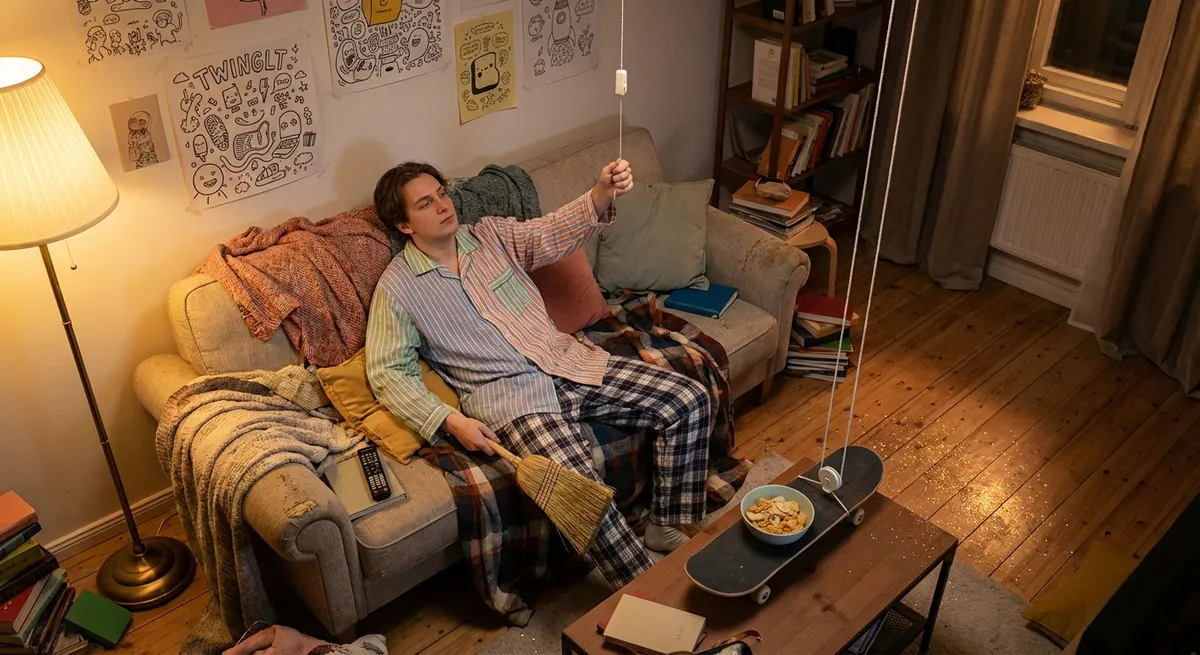
If you’ve ever thought, “There has to be a lazier way to do this,” congratulations: you’re the target audience. This is not about becoming a perfectly optimized productivity robot. This is about doing the bare minimum so cleverly that it looks like you’ve got your life together. These are the hacks for people who want results, but also naps, snacks, and Wi‑Fi.
Welcome to low-effort wizardry: where we do more with less… mostly less.
1. The “Future Me Is an Idiot” System
You are not the same person every day. There’s “Motivated You” (rare, mythical), and there’s “Potato On The Couch You” (common, powerful). The problem is: Potato You has to deal with the chaos left by Motivated You’s “I’ll remember that later” lies.
Solution: start assuming Future You is an idiot. Label and prep everything as if you’re helping a confused stranger who just woke up from a 300-year nap.
Practical ways to do this:
- Put sticky notes where the chaos happens: on the fridge, front door, by the bed, on your laptop. “Take laptop charger.” “Garbage day.” “DID YOU EAT REAL FOOD.”
- Name folders and files like you’re writing for a toddler: “Taxes 2024 – FOR REAL THIS TIME,” “Photos – Do NOT Delete,” “Rent Receipts – Pls Don’t Lose.”
- Use calendar events with aggressive clarity: “Pay electricity bill OR LIVE IN DARKNESS.”
- Pre-pack “idiot-proof” kits: a “leaving the house” tray by the door with keys, wallet, headphones, and lip balm. If you leave with nothing else, at least you’re moisturized and can block out noise.
This is not about self-hate. It’s about accepting a universal truth: Future You can’t be trusted to remember anything without big fonts and mild threats. Once you embrace that, things stop falling through the cracks—and you can save your brainpower for more important decisions, like which show to binge next.
2. Weaponize Your Laziness: Make Doing Nothing the Default
Humans are simple: we usually do what’s easiest, not what’s best. So don’t try to become “disciplined.” Just change what “easy” means.
Turn laziness into a weapon:
- Put your phone charger in the most boring spot in your home. If you want to mindlessly scroll, you have to stand in the kitchen like a phone-gremlin.
- Make “healthy-ish” the path of least resistance: pre‑cut fruit, pre‑washed salad, nuts on the counter, chocolate at the very back of the cupboard behind that bag of lentils you bought once and feared.
- Put the TV remote across the room next to your yoga mat or dumbbells. If you’re going to walk over there anyway, you might as well do 10 squats. (Yes, standing up and sitting back down twice counts.)
- Keep a reusable bag inside your daily backpack or purse so you always “accidentally” remember it when shopping.
- Make bad habits mildly annoying: if you love late-night snacks, put them in opaque containers on the highest shelf. If you still climb for them at 1am, you’ve technically worked out.
By making the good stuff easier and the chaos slightly more annoying, you’re not becoming a new person—you’re just gently bullying yourself into better decisions.
3. The 30-Second Tidy Illusion (Guests Think You’re Functional)
Nothing motivates cleaning like a text that says, “I’m five minutes away.”
You don’t need a spotless home; you just need it to look like you’re not living inside a laundry basket. Enter: the 30-second tidy illusion—rapid-fire damage control that makes your place look 50% cleaner with 5% effort.
Hit these visual hotspots:
- Surfaces first. Clear counters and tables. Don’t organize—just remove visible clutter. Put it all in one “Shame Basket” to deal with later. (Will you? Unclear. But that’s Tomorrow You’s problem.)
- Bathroom decency mode. Close the toilet lid, pull the shower curtain closed, wipe the mirror with a bit of water and a towel. Replace “near death” towel with your “visitor towel” that doesn’t look like it survived a medieval plague.
- Scent hack. Open a window for 2 minutes and light a candle or spray something vaguely “forest,” “ocean,” or “this doesn’t smell like stress sweat.”
- Lighting illusion. Turn on warm lamps, not overhead lights. Dim lighting hides 80% of sins and 100% of dust.
Your guests will walk in and think, “Wow, this is cozy and put together,” not realizing there’s a pile of chaos shoved in your closet like a Tetris disaster. That’s between you and your door hinges.
4. The “Two-For-One Brain Trick” (Level Up Without Trying That Hard)
Multitasking usually turns your brain into mashed potatoes. But there is a sneaky way to do two things at once without becoming useless at both: pair something mindless with something meaningful.
Think of it as “life stacking” instead of multitasking:
- Listen to an audiobook, podcast, or language lesson while doing dishes or laundry. Your hands are on autopilot; your brain gets the upgrade.
- Do gentle stretches while watching Netflix. You can still rewatch that comfort show for the sixth time, but now your hips don’t feel like ancient door hinges.
- Use your commute or walk to voice-record notes to yourself: ideas, to-dos, chaotic thoughts. Later, skim the transcript or notes and pretend you’re your own personal assistant.
- On hold with customer service? That’s plank time. Or wall sits. Or “pick up three random things off the floor” sprints.
The key: one task must be low-brain (dishes, walking, folding laundry), and the other can be growth, learning, or health. You’re not working “harder”—you’re just slipping vitamins into the brain’s mac and cheese.
5. Social Scripts for Awkward Humans (Because Small Talk Is a Side Quest)
Some people are naturally smooth in social situations. The rest of us mentally rehearse “Hi” five times and still panic when someone says, “How’ve you been?”
You can hack social life not by becoming extroverted, but by pre-loading your brain with “scripts” so you don’t blue-screen in real time.
Try these:
- Replace “We should hang out sometime” (a lie) with “Are you free next Thursday or Saturday?” Specific = real.
- When your brain is blank, use the “3F Formula”: ask about Food, Free time, Future
- “Tried any good food places lately?”
- “What do you usually do to unwind after work?”
- “Anything you’re looking forward to this month?”
- When you want to leave a convo without being weird:
- “I’m going to grab some water, but it was so good catching up.”
- “I’m going to say hi to a couple more people before I run—so glad I saw you.”
- Decline plans without guilt using this two-part combo:
- Honest but short: “This week’s really packed for me.”
- Offer an alternate that you can handle: “But I’d love to do a quick coffee next weekend if you’re around.”
Social scripts don’t make you fake; they just reduce the loading time between your brain and your mouth. It’s like having cheat codes for human interaction—less awkward buffering, more actually having a good time.
Conclusion
Life hacking doesn’t have to be this huge aesthetic transformation where your desk is minimalist, your mornings start at 5am, and your breakfast involves chia seeds you can’t even spell correctly.
It can just be:
- Accepting that Future You is unreliable and planning accordingly
- Letting your laziness work for you instead of against you
- Faking cleanliness just enough to pass inspection
- Sneaking self-improvement into boring chores
- Using social scripts so your brain doesn’t panic every time someone says “So, what’s new?”
If any of this made you think, “Wow, I could actually do that,” congratulations: you’re already 1% more upgraded. Now go share this with someone whose life is held together by vibes and charging cables.
They’ll know you saw them.
And they’ll probably send you this back with, “Why is this so specifically about me?”
Sources
- [U.S. Department of Health & Human Services – Healthy Habits](https://health.gov/myhealthfinder/topics/everyday-healthy-living/mental-health-and-relationships/healthy-habits) – General guidance on building sustainable health habits and routines
- [Harvard Business Review – Why We Procrastinate and How to Stop](https://hbr.org/2017/10/why-we-procrastinate-and-how-to-stop) – Explores the psychology of procrastination and practical strategies to work with your future self
- [Cleveland Clinic – The Power of Habit Stacking](https://health.clevelandclinic.org/habit-stacking) – Explains how pairing small tasks together can make habits easier to maintain
- [American Psychological Association – Multitasking: Switching Costs](https://www.apa.org/research/action/multitask) – Breaks down why traditional multitasking doesn’t work and what to do instead
- [Mayo Clinic – Stress Management and Social Support](https://www.mayoclinic.org/healthy-lifestyle/stress-management/in-depth/social-support/art-20044445) – Discusses how improving social connections and communication can support mental well-being