You know those people who wake up at 5 a.m., drink lemon water, journal, run a marathon, and answer 47 emails before you’ve even unlocked your phone? This article is not for them. This is for the “hit snooze 8 times and maybe drink water by 3 p.m.” crowd.
These are low-effort, high-chaos life hacks that actually work, require almost no discipline, and make you look suspiciously put-together to other humans. Read them, steal them, pretend you invented them. We won’t snitch.
The “Lazy Autopilot” Trick: Make Your Future Self Too Confused To Fail
Your brain loves routines so much it will happily repeat bad ones forever (hi, doomscrolling), but you can hijack that autopilot with very dumb, very effective tweaks.
Put the thing you should be doing exactly where your zombie self can’t ignore it. Phone goes in your sneaker at night so you physically have to stand up to silence the alarm. Water bottle lives on your pillow so you literally have to move hydration to lie down. Charging cables only exist at a desk, so “just checking TikTok” somehow equals “also technically sitting in a work zone.”
Is this manipulation? Yes. Are you manipulating yourself? Also yes. Congratulations, you are your own evil UX designer.
The magic: you’re not using willpower (which disappears the second someone offers fries). You’re using friction. Bad habits become annoying. Decent habits become slightly easier than being a goblin. You don’t become a new person; you just become a slightly upgraded goblin with better defaults.
This is the whole hack: don’t ask “How do I become more disciplined?” Ask, “How do I make the dumb thing harder and the useful thing stupidly convenient?”
The “Two-For-One” Rule: Stack Boring Stuff On Top Of Fun Stuff
If something is boring, your brain will stall like a Windows XP computer. So you bribe it. Shamelessly.
Pair every tedious task with something you genuinely enjoy:
- Only listen to your favorite drama-filled podcast while doing dishes.
- Save your comfort show exclusively for folding laundry.
- Keep your favorite snack as “email tax” while answering messages.
- Walk while voice-noting friends so “exercise” secretly becomes “sending chaotic updates.”
This is called “habit stacking” in fancy science language, but in real life it’s “emotional blackmail for your own nervous system.” If your brain wants the fun thing, it has to tolerate the boring thing as collateral.
Important rule: never let the fun thing escape the boring task. If you start watching that comfort show in bed, your brain will say, “Cool, we no longer need laundry to access dopamine,” and your clothes will become a permanent floor garnish.
Do it right, and suddenly chores become “that thing I do while catching up on unhinged internet drama,” and you trick your brain into thinking you’re having a decent time.
The “Invisible Meal Prep” Move: Feed Yourself Without Actually Cooking
Meal prep sounds like “Sunday you” is applying to be a private chef for the rest of the week. In reality, you can achieve 80% of the benefit with 20% of the effort and exactly 0% of the glass Tupperware aesthetic.
Think less “gourmet prep” and more “future me will be feral and must be contained.” For example:
- Pre-cut basic stuff: chop a pile of veggies once (peppers, carrots, cucumbers), then throw them into literally everything until you’re bored or they’re gone.
- Choose a default emergency meal: eggs + toast, frozen dumplings, canned beans + tortilla. Boring is fine; “edible in 7 minutes” is the main KPI.
- Keep a “panic shelf”: tortillas, canned soup, microwave rice, frozen veggies, shredded cheese. That’s like 9 meals in disguise.
- Buy pre-chopped, pre-washed, pre-anything if you can. You’re not paying for laziness; you’re paying for “I will actually eat this instead of Uber Eats for the fourth time.”
Your goal is not to become Gordon Ramsay; your goal is to prevent 9 p.m. you from staring into the fridge like it’s a haunted portal and then ordering $27 noodles because “there’s nothing to eat.”
If you can make “barely trying” equal “somewhat nourished,” you’ve already beaten half of adulthood.
The “Outsource To Your Environment” Method: Let Objects Babysit Your Life
Your environment can remember things so your brain doesn’t have to—because your brain is currently busy reciting every embarrassing thing you did in middle school.
Turn your space into a physical to-do list:
- Put your vitamins inside your coffee mug cabinet. Mug in hand? Vitamin in hand.
- Toss your gym clothes on the chair near the door so you have to either put them on or admit defeat and move them. Either way, you thought about it.
- Keep a “launch pad” by the door: keys, bag, headphones, anything you routinely forget and then hate yourself for.
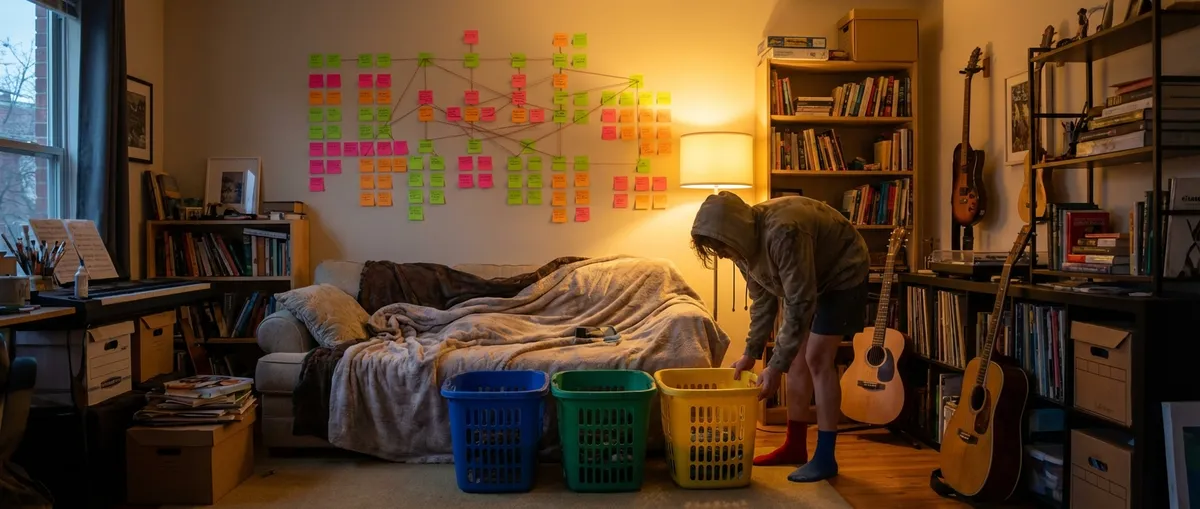
- Use sticky notes in ridiculous places: “Did you drink water?” on your laptop, “Turn off stove” on your front door, “Stop doomscrolling” on your ceiling (for the dramatic thinkers).
You’re not building “discipline”; you’re building bumpers for your life like it’s bowling and you’re five.
Every time you forget something, don’t just roast yourself. Ask: “What object could have yelled at me about this?” Then recruit that object. Congratulations, your house is now your chaotic but helpful project manager.
The “Micro-Win Snowball” Effect: Weaponize Stupidly Tiny Victories
Most self-help advice is like: “Change your life in 30 days!” Meanwhile, you’re just trying to answer one email you’ve been avoiding since the last ice age.
Enter: the micro-win. Instead of trying to be impressive, aim to be barely functional—but consistently.
Examples:
- Too tired to clean your room? Pick up three things. Just three.
- Can’t face a workout? Do 5 squats, 5 pushups against the wall, walk around your home once. Call it your “Gremlin Circuit.”
- Afraid to open scary emails? Set a 2-minute timer: open as many as you can, no replies required. Closing them is Future You’s problem.
- Overwhelmed by a project? Write the dumbest, ugliest first sentence or bullet point. You can fix it later; step one is breaking the curse.
Each tiny thing gives your brain a tiny “I did it” hit. Do enough micro-wins and suddenly your day feels less like failing at one big task and more like winning 12 stupid little games.
Your life doesn’t change in one glowing montage. It changes because you picked up three socks every day for six months and accidentally became someone who doesn’t live in a textile avalanche.
Conclusion
You don’t need a color-coded planner, a sunrise yoga habit, or a personality transplant to get your life vaguely together. You just need to:
- Make the good stuff easier than the chaos
- Staple fun onto boring things
- Stock “barely cooking” food
- Let your stuff boss you around
- Stack ridiculous tiny wins until they stop feeling ridiculous
You’re not trying to become a new person; you’re just editing the settings on the one you already are. And if all else fails, at least you’ll have a panic shelf, a hydrated brain, and a house full of objects silently judging you into being 12% more functional.
Now go share this with someone who “just needs motivation” but actually needs trickery, snacks, and industrial-strength laziness hacks.
Sources
- [Harvard Health – Simple Tips to Improve Your Eating Habits](https://www.health.harvard.edu/blog/8-steps-to-mindful-eating-201601089057) - Backs up the idea that small, simple food habits (like defaults and prep) can significantly improve nutrition.
- [NPR – The Science of Habits: How They Form and How to Break Them](https://www.npr.org/2012/07/06/156507111/the-power-of-habit-in-life-business) - Explains how routines and environmental cues drive behavior, supporting the “autopilot” and environment-based hacks.
- [CDC – Physical Activity Basics](https://www.cdc.gov/physicalactivity/basics/index.htm) - Shows that even modest levels of movement have real health benefits, aligning with micro-wins and tiny “workouts.”
- [American Psychological Association – The Secret to Better Habits: Make Tiny Changes](https://www.apa.org/news/apa/2022/tiny-habits-big-changes) - Discusses how very small, consistent actions can lead to lasting behavior change, echoing the micro-win approach.
- [Stanford University – Behavior Design Lab (BJ Fogg)](https://behaviordesign.stanford.edu/) - Foundational research on habit stacking and tiny behaviors as a path to sustainable improvement.