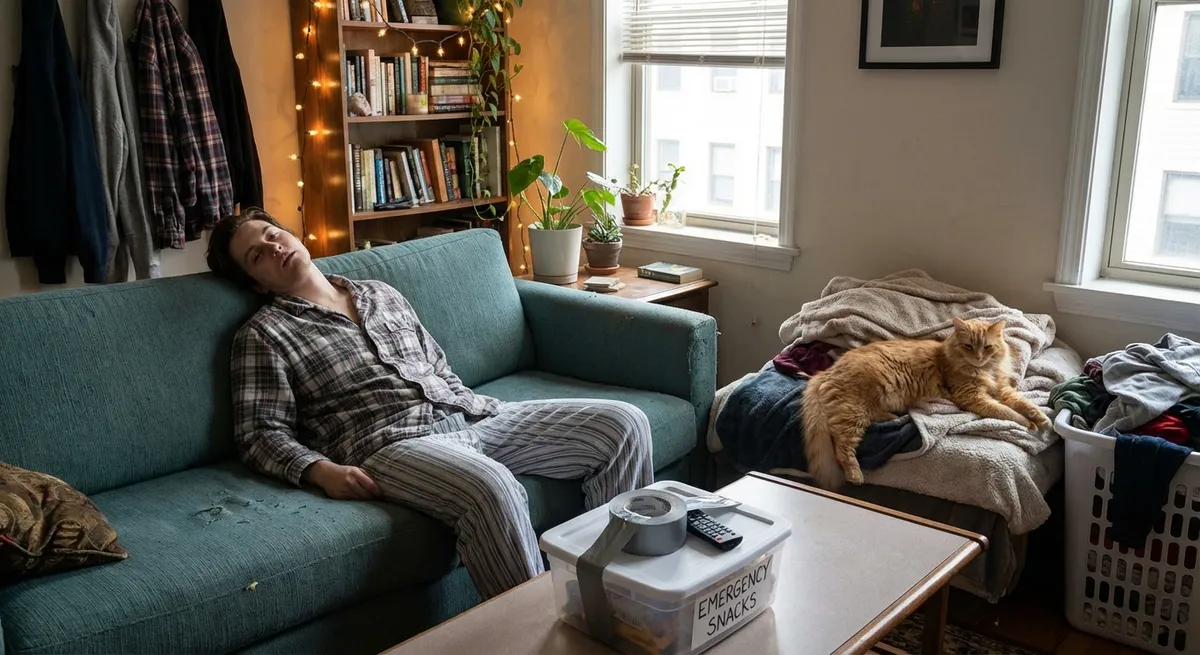
You know those hyper-productive people who wake up at 5 a.m., drink kale, run a marathon, and write a novel before work? This article is not for them. This is for you: the “I will absolutely lie to the delivery app and say I’m at the door when I’m still in bed” demographic.
These are life hacks for people whose main personality trait is “perpetually low battery,” but who still want their life to feel 10% more put-together with 0.5% more effort. They’re weird. They’re slightly unhinged. They work.
1. The “Future Me Is an Intern” Trick
Your future self is not a wise, organized adult. Your future self is an unpaid intern who has to deal with whatever chaos you leave behind. Once you accept this, your whole life changes.
Before you leave a room, do one thing your “future intern” will thank you for:
- Toss one obvious piece of trash
- Put one dish in the sink or dishwasher
- Lay out one thing you’ll need tomorrow (keys, headphones, charger, etc.)
- Open the window for 30 seconds so Future You doesn’t wake up in stale air and regret
You’re not “being productive.” You’re just not bullying your future intern.
The psychology here is actually backed by science: tiny, easy wins are way more sustainable than massive “new me” overhauls. Behavioral research shows that small, low-friction habits are far more likely to stick than big dramatic ones. You’re basically hacking your laziness into something useful.
2. The Lazy Person’s Outfit System (a.k.a. “Cartoon Character Mode”)
Decision fatigue is real. If you open your closet and feel your soul leave your body, this is for you.
Pick one “safe default” outfit that:
- You feel decent in
- You can wear almost anywhere casual
- Won’t make you spiral if you see a photo of yourself later
- Make 2–3 variations of that same general outfit (same formula, different colors)
- Put them together on hangers or in a specific drawer
- When your brain is mush: wear one of those. No thinking. No “fashion show in the mirror.” Just cartoon character mode.
Now:
High performers do this too (think Steve Jobs’ turtleneck and jeans situation), but you’re doing it because you’re too tired to emotionally negotiate with your wardrobe at 8 a.m. Same result, different vibe.
Bonus: When your “fashion energy” is actually high, you can still go wild. The default outfits are just emergency rations for your confidence.
3. The “One Screen at a Time” Energy Hack
You know when you’re watching Netflix while scrolling TikTok while checking messages and then somehow 3 hours pass and you feel both overstimulated and bored? Yeah, your brain hates that.
Try this cursed-but-magic rule:
If your brain is tired, reduce screens, not tasks.
Instead of:
- TV + scrolling + texting + “half-working”
- TV only
- Or: scrolling only
- Or: texting only
- Or: actually work for 15 minutes and then stop like a chaotic legend
Do:
Your brain uses energy to task-switch. When you think you’re “relaxing” while multitasking, you’re actually yeeting your mental battery into the sun. Focusing on just one thing at a time lowers cognitive load and makes whatever you’re doing feel more satisfying and less draining.
Plus, when you actually watch a show without your phone, you notice that characters have names and plots exist. Wild.
4. Turn Your Phone into a Friendly Bouncer, Not a Chaos Portal
Your phone can either be your tiny handheld goblin of distraction or a surprisingly decent assistant. Minimal effort, big payoff:
- Move all your “problem apps” (social media, games, shopping) to the second or third screen
- Put boring-but-useful apps on the front (calendar, notes, maps, banking)
- Rename a few shortcuts in a mildly threatening way:
- “Instagram” → “Do You Really Have Time For This?”
- “Shopping” → “You’re Avoiding Something”
- “Games” → “This Is a Trap, Babe”
You’re not blocking yourself from your vices. You’re just inserting 1.5 seconds of “Do I actually want this?” between your impulse and your action—which is often enough to make your brain go, “Eh, never mind.”
Studies on “nudges” and choice architecture show that rearranging what’s easy vs. what’s annoying affects behavior a lot more than sheer willpower. You’re not becoming disciplined; you’re just getting sneaky.
5. The “Mildly Dramatic Main Character” Clean-Up Method
Traditional cleaning:
“I will clean the entire apartment today.”
Result: One (1) wiped counter, three breakdowns, and a nap.
Main character cleaning:
Turn every 3–5 minute task into a weirdly cinematic mini-scene. You are not cleaning. You are “doing a montage.”
Examples:
- Put on one dramatic song and clean only the surfaces you can reach before it ends
- Pretend you’re in a “24 hours before they arrive” scene and your only job is to make the place look 20% less concerning
- Narrate in your head like a nature documentary: “Here we observe a rare sighting: a human adult putting laundry in the basket instead of beside it.”
The bar is not “spotless.” The bar is “significantly less tragic.”
Short bursts of effort are easier for your brain to accept than “big clean” energy. You can absolutely trick yourself into doing more with the illusion that you’re just doing “a tiny bit for the aesthetic.”
Conclusion
Your life does not need a full reboot. It needs a series of small, slightly unhinged upgrades that work with your laziness instead of against it.
Treat your future self like an overworked intern. Dress like a low-maintenance cartoon character when your brain is fried. Stop running a 37-tab circus in your head with every screen at once. Make your phone slightly judge you. Clean like you’re in a chaotic indie movie montage.
None of this will turn you into a hyper-optimized productivity robot—but that’s kind of the point. You’re still you, just with fewer daily “how did my life get like this” moments.
And honestly? That’s the type of chaos glow-up people actually share.
Sources
- [American Psychological Association – Multitasking: Switching costs](https://www.apa.org/research/action/multitask) – Explains how task-switching drains mental energy and reduces performance
- [Harvard Business Review – To Build New Habits, Get Comfortable Failing](https://hbr.org/2020/09/to-build-new-habits-get-comfortable-failing) – Discusses why small, low-pressure habits are more sustainable than ambitious overhauls
- [Nudge Theory Overview – University of Chicago Booth Review](https://www.chicagobooth.edu/review/nudge-theory) – Outlines how small changes in choice architecture (like app placement) can influence behavior
- [Cleveland Clinic – Decision Fatigue: What It Is and How to Beat It](https://health.clevelandclinic.org/decision-fatigue) – Breaks down why too many choices (like outfits) can exhaust your brain
- [National Library of Medicine – The Cognitive Costs of Multitasking](https://www.ncbi.nlm.nih.gov/pmc/articles/PMC500362/) – Research on how divided attention impacts productivity and mental performance