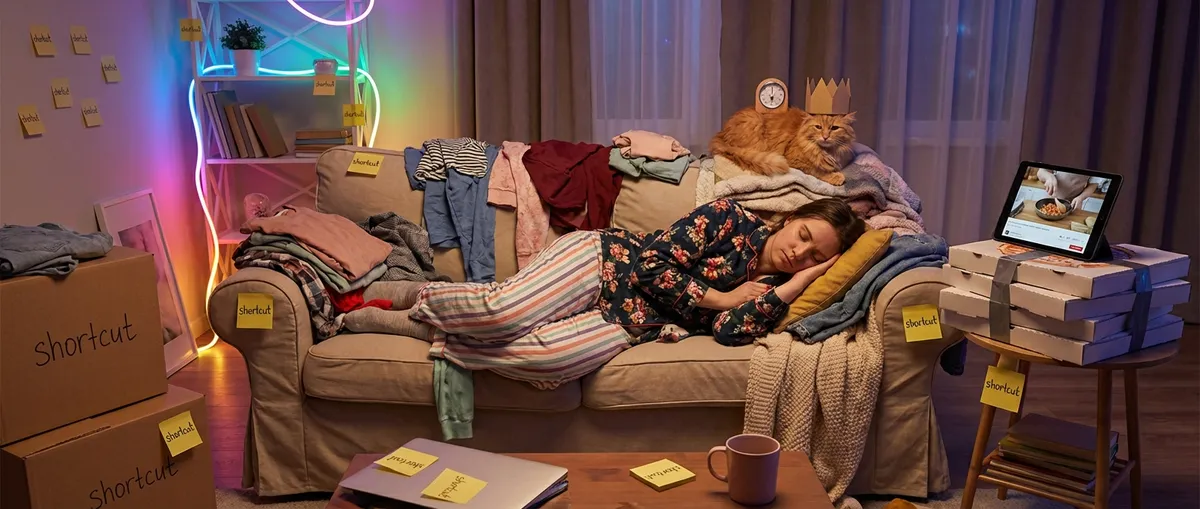
You know that feeling when your brain wants to be a “high-performance productivity machine,” but your body is a glorified house plant that occasionally checks email? This is for you.
These are not “wake up at 5 a.m. and juice a beet” hacks. These are “I have three brain cells left and two of them are buffering” hacks. They’re oddly effective, mildly unhinged, and scientifically adjacent enough that you can defend them in a group chat.
Share this with a friend who insists they’re “fine” but has 47 tabs open and a fork in the microwave.
The 3‑Item To‑Do List That Tricks Your Brain Into Finishing Stuff
Your normal to‑do list: 28 items, spirals into existential dread, mysteriously regenerates overnight.
The 3‑Item To‑Do List: legally not overwhelming.
Here’s the move:
Every morning (or whatever your version of “morning” is), write down only three things you must do today. Not “should,” not “would be nice,” but “if these don’t happen, tomorrow is on fire.” That’s your entire list.
Everything else? Bonus level. Side quests. If you finish your 3, you can either stop and declare victory or flex on your own brain and do extra.
Why it works:
- Your brain hates vague doom but loves winnable games. Three items feels like a game. 28 feels like punishment.
- You’re narrowing attention, which research shows reduces decision fatigue and boosts follow‑through.
- Finishing even tiny tasks gives your brain a hit of dopamine, which quietly whispers, “Maybe we can do things.”
Pro tip:
Make at least one item absurdly achievable, like “Send that 30‑second text I’ve avoided for 11 days.” Finishing it gives you early momentum. You basically speed‑run the day’s confidence.
This is the to‑do list equivalent of lowering the bar so you can easily step over it instead of attempting an Olympic pole vault while emotionally horizontal.
Weaponize Your Laziness With “Friction Hacking”
You’re not unmotivated, you’re just aggressively optimized for path of least resistance. Use that.
“Friction” is anything that makes a habit harder to start: a missing charger, a login screen, your couch seducing you into oblivion. Instead of fighting yourself, edit your environment so the good stuff is stupidly easy and the chaos requires effort.
Examples that feel illegal but are not:
- Put your phone charger across the room so doomscrolling in bed requires getting up. You won’t. Your future eyeballs thank you.
- Store snacks you want to eat more of (fruit, nuts) on the counter and the chaos snacks in an annoying place (top shelf, behind the rice cooker you never use).
- Set up “one‑click start” stations:
- A water bottle already filled on your desk
- Shoes + keys by the door
- Workout clothes stacked in one grab‑and‑go pile instead of scattered like a crime scene
The science angle: studies on “choice architecture” show that when you change how easy or hard something is to access, people’s behavior shifts without them needing more willpower. You are not becoming a new person; you are simply booby‑trapping your laziness in your favor.
Bonus chaos move: log out of social media on your main browser. Only one app stays logged in. Extra clicks mean you’re slightly less likely to fall into a 2‑hour scroll vortex. Slightly. Let’s not lie to ourselves.
The 10‑Minute “Fake Start” That Outsmarts Procrastination
Your brain: “We don’t have time/energy/mental stability to do this.”
Also your brain: spends 45 minutes watching a raccoon wash cotton candy in a puddle.
Enter: the Fake Start.
Tell yourself you’re only working on a task for 10 minutes. You are not committing to finish. You are merely poking it with a stick. After 10 minutes, you’re allowed—encouraged, even—to stop.
Here’s why this bizarrely works:
- It bypasses your brain’s “ugh, huge task” alarm and reframes it as “small and temporary.”
- Getting started is the hardest part; once you’re in motion, your brain often decides, “We’re here anyway, might as well keep going.”
- Even if you stop after 10 minutes, you’ve reduced the “first step” friction for next time.
- Use a timer. Don’t wing it. Winging it is how we got here.
- Break the first 10 minutes into embarrassingly tiny steps: open the document, name the file, write a sloppy first sentence that you will absolutely insult later.
- When the timer goes off, pause and ask: “Do I genuinely want to stop, or am I just used to quitting?” If you want to keep going, reset for another 10. If you want to tap out, congratulations, you still did more than yesterday.
How to make it actually stick:
This turns productivity into a series of micro‑bets instead of a mythical 6‑hour concentration marathon you will never, ever perform outside of a video game.
Turn Boring Tasks Into Ridiculous Mini‑Games
Your brain loves games. Sadly, life insists on dishes, email, and forms that ask you to “upload a document in PDF format” like that’s not a whole side quest.
Solution: absurd gamification.
You don’t need an app. You need unhinged rules that entertain you enough to get through the boring stuff.
Ideas you’re absolutely allowed to steal:
- Speed run the dishes while a single song plays. If they’re not done before the chorus ends, you “lose.” Nothing happens, except you did the dishes.
- Answer emails only in batches of five. After five, you “unlock” a reward: 5 minutes of scrolling, a snack, or shouting into the void.
- Laundry boss battle: each completed load = 1 XP. Three loads = you “earn” the right to not fold the socks. (Matching socks is a scam made up by Big Laundry.)
- Cleaning playlist rule: you can only listen to your most chaotic hype playlist while tidying. No cleaning = no playlist. Your brain now associates cleaning with joy and unwise dance moves.
Why this works: gamification taps into reward pathways in your brain and makes repetitive tasks suck less. You’re layering fun on top of obligation, like putting sprinkles on broccoli, except it kind of works.
Also, it gives you a story to tell your friends: “I just beat Level 3: Countertop Catastrophe” is objectively funnier than “I wiped the counters.”
The “Future You” Bribe System (Advanced Goblin Psychology)
If you respond better to bribes than discipline, welcome home.
The “Future You” bribe system is simple: before doing something annoying, create a specific, earned reward that only Future You gets if Present You does the thing.
Key rules:
- The reward must be mildly exciting: an episode of your favorite show, fancy coffee, guilt‑free couch scrolling, ordering takeout.
- It has to be locked behind the task. Not “I’ll watch Netflix and then maybe clean” but “Once the floor is visible, then Netflix.”
- Make it visible. Write it down: “After I finish this assignment: bubble tea and zero human interaction.”
- You’re creating a mini “if‑then” contract, which research shows helps people stick to behaviors.
- You’re reframing the task from “annoying obligation” to “ticket to something nice.”
- Anticipation itself is rewarding—your brain gets little dopamine previews while you work.
- Task: One boring adult phone call
- Reward: 20 minutes reading a fun book, or a walk, or a guilt‑free nap with no “I should be doing something” soundtrack.
Why your goblin brain falls for this:
Bonus twist: sometimes make the reward something that supports your energy instead of nuking it. Example:
You’re not just doing life admin—you’re running a psychological loyalty program for yourself. Congratulations, you are both the customer and the mildly corrupt manager.
Conclusion
You don’t need to become a different person to make your life run smoother. You just need to:
- Shrink your to‑dos to something winnable
- Rig your environment so the easiest choice is the best one
- Lie to your procrastination with 10‑minute fake starts
- Turn chores into dumb games
- Bribe Future You like the dramatic little creature you are
These are chaos‑compatible hacks: designed for real humans who are tired, mildly overwhelmed, and still low‑key determined to pull off a decent life.
Send this to someone who is “working on it” but currently horizontal, scrolling, and drinking coffee at 4 p.m. They are our people.
Sources
- [American Psychological Association – Procrastination Research](https://www.apa.org/news/press/releases/2010/04/procrastination) – Explains why we delay tasks and how strategies like breaking work into smaller pieces can help.
- [Harvard Business Review – Manage Your Energy, Not Your Time](https://hbr.org/2007/10/manage-your-energy-not-your-time) – Discusses why energy and attention management often beat pure time management, supporting ideas like short sprints and rewards.
- [Nudge Theory Overview – University of Chicago Booth Review](https://www.chicagobooth.edu/review/what-nudge) – Breaks down how small changes in “choice architecture” can influence behavior, similar to reducing friction for good habits.
- [Mayo Clinic – Gamification and Motivation Concepts](https://www.mayoclinic.org/healthy-lifestyle/adult-health/expert-answers/motivation-tips/faq-20057770) – Covers motivation tips and how rewards and fun can reinforce healthy behaviors.
- [American Journal of Lifestyle Medicine – Habit Formation Research](https://journals.sagepub.com/doi/10.1177/1559827617729634) – Reviews how consistent small actions and environmental cues help build sustainable habits over time.