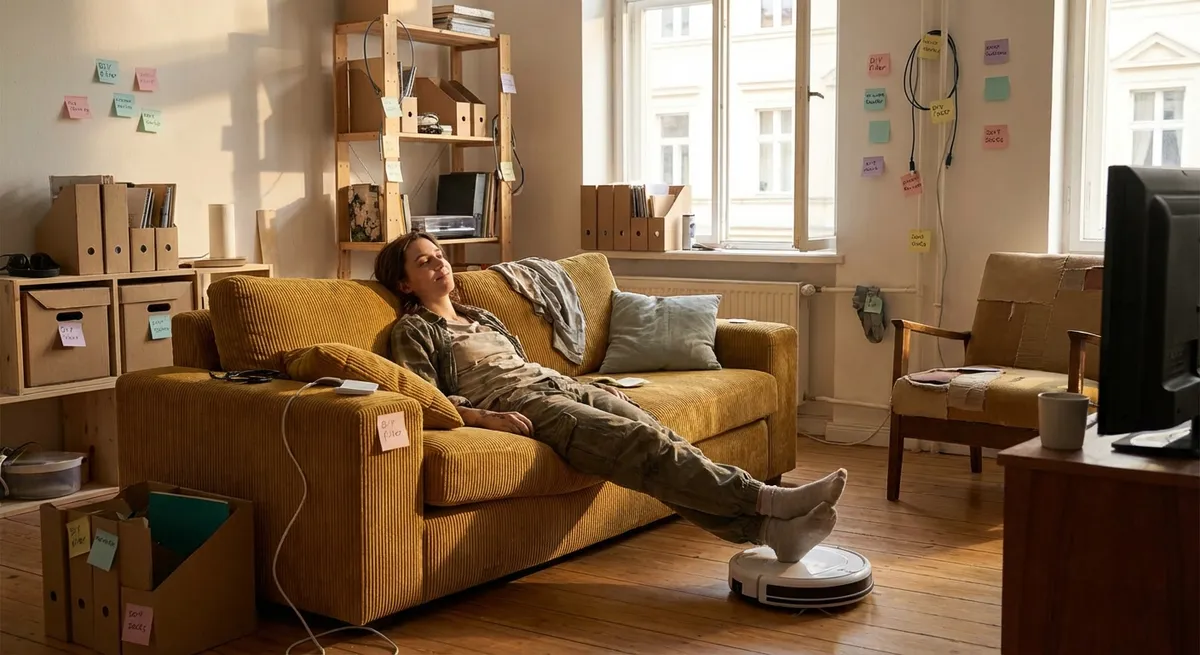
You know those super-productive people who wake up at 5 a.m., drink room-temperature lemon water, and “crush their goals”? This article is not for them. This is for you: the person who unpauses Netflix to find the remote that was in your hand the whole time.
Welcome to the art of getting your life together just enough using tricks that feel like cheating, work with minimum effort, and make you look suspiciously competent. These are the kinds of hacks your friends will DM each other with, followed by: “Why does this actually slap?!”
1. The “Invisible Decision” Hack: Outsmart Future You (Who Is Useless)
Future You cannot be trusted. Future You will ignore alarms, forget deadlines, and eat cereal for dinner again. So stop asking Future You to remember anything and start booby-trapping your own life.
Instead of “I’ll remember,” make the world physically annoy you until you act. Want to drink more water? Put your water bottle directly on top of your phone or laptop—no hydration, no scrolling. Need to bring something to work? Put your keys on top of it so you literally can’t leave without grabbing it. Trying to read more? Put your book on your pillow when you make the bed so you have to touch it before sleeping.
This works because your brain is lazy (relatable) and responds better to obvious visual cues than to noble intentions. You’re not becoming more disciplined; you’re just making it harder to be chaotic. Think of it as passive-aggressively parenting yourself, using the environment as your nagging mom.
Your friends will share this one because it’s the rare advice that admits: discipline is fake, traps are real, and we’re all just setting bear traps for our bad habits.
2. The “90-Second Reset” for When Your Life Looks Like a Before Photo
Your space doesn’t need a full makeover. It needs to look “not haunted.” Enter: the 90-second reset.
Here’s how it works: pick one small area—the couch, your desk, your nightstand, the kitchen counter—and give yourself 90 seconds to restore it to “if someone saw this, I wouldn’t die of shame” mode. No deep cleaning. You are not Cinderella. You are doing a vibe refresh.
Dump trash, stack plates, shove things into a designated “Chaos Basket” (highly scientific term) you deal with later, fluff a pillow, swipe crumbs into the sink. When the timer ends, stop. You’re done. The point is not perfection; it’s going from “I live in a side quest” to “I might pay taxes and have opinions about olive oil.”
Why this secretly works: clutter predictably messes with your focus and stress levels way more than you think. But the idea of “cleaning the apartment” is so huge your brain immediately files it under “not happening.” Ninety seconds? Your brain reluctantly agrees, and you get a tiny hit of smug satisfaction when the area looks less like a crime scene.
This is extremely shareable because everyone has That One Demon Corner of the room, and now they can pretend they’re doing mental health work by putting socks in a hamper.
3. The “Brain Buffer” Trick: Ending Tasks 1% Before You’re Done
Finishing things is hard. Starting things is harder. That’s why we stop mid-task, feel guilty, then abandon everything like a raccoon who heard a noise.
So here’s the move: whenever you’re working on something that takes focus—studying, cleaning, creating, planning—intentionally stop when you’re almost done, not when you’re completely toast. Leave yourself a tiny, obvious next step.
Stop the homework when you have one easy paragraph left. Stop writing the email when you only need to add the last sentence. Stop cleaning when you only have a small, satisfying thing left (like wiping one surface).
What you’re doing is creating a “brain buffer.” Future You doesn’t have to figure out how to start; they just have to finish the last 1% that’s stupidly easy. That tiny momentum often drags you into doing more, almost by accident.
It feels like cheating because our brains love unfinished things—they itch to close the loop. You’re turning your attention span into a cliffhanger episode of a show: “Previously, on You Trying To Get Your Life Together…”
People share this because it sounds fake, feels sneaky, and actually makes starting tasks way less painful. Also, it’s the exact opposite of “push until you’re exhausted,” which everyone is secretly tired of pretending to like.
4. The “Social Pressure Without the People” Hack
You know how you suddenly become a functioning adult when someone is coming over in 20 minutes? You’re cleaning, hiding dishes in the oven, and folding laundry at anime speed. That’s “social pressure mode,” and you can weaponize it—no humans required.
Try one of these:
- Fake coworker mode: Put your laptop somewhere public-ish (coffee shop, library, even a different room at home) and act like other people can see your screen. You will magically stop doom-scrolling and start doing the thing.
- Accountability note: Leave a sticky note on your desk that says, “Did you actually do [task] or are you lying to yourself again?” It’s stupid. It works. You will feel personally attacked by a Post-it.
- Public commitment lite: Tell one low-drama person, “I’m doing [specific task] today. I’ll text you when it’s done.” Not a big accountability group. Just one person so you don’t want to admit “Nah, I chose chaos instead.”
Humans are wired to care what other people think; it’s how we survived long enough to invent iced coffee and wireless headphones. You’re just borrowing that ancient wiring and applying it to your inbox instead of avoiding tigers.
This hack spreads fast because it taps into the universal experience of being 10x more competent the second another person is involved—and turns it into a solo superpower.
5. The “Upgrade One, Ignore the Rest” Rule (For When Self-Help Feels Like Spam)
The internet is constantly screaming: drink water, wake up early, meditate, stretch, journal, eat clean, walk 10k steps, and also be chill about it. No.
Enter: the “Upgrade One, Ignore the Rest” rule.
Instead of trying to transform your entire personality this week, pick one tiny life category and give it a glow-up—then let everything else be aggressively average.
Examples:
- Sleep upgrade: Same chaotic diet, same questionable decisions, but you protect your sleep time like it’s the last slice of pizza. Everything feels 30% less terrible.
- Food upgrade: You still procrastinate and forget laundry, but you add one decent meal or snack to your day. Your brain gets enough fuel to at least want to function.
- Movement upgrade: Stay a goblin in all digital ways, but you walk 10–15 minutes a day. Think of it as your daily software update for your brain and mood.
This works because your life doesn’t need a total reboot; it needs one reliable pillar so everything doesn’t collapse at once. That one improved area quietly drags everything else up a notch without you having to become “morning routine person” who owns too many mason jars.
It’s share-worthy because it’s anti-perfection. It doesn’t ask you to be your “best self.” It asks you to be “slightly less chaotic in exactly one way,” which is finally a goal that feels realistic.
Conclusion
You don’t need 47 productivity apps, a bullet journal that looks like fan art, or the willpower of a Navy SEAL. You need tiny hacks that respect the truth: you’re busy, kinda tired, a little overwhelmed, and still trying your best while half your brain is buffering.
Turn your home into a series of helpful traps. Give yourself 90-second resets instead of 3-hour cleaning marathons. Stop tasks right before the easy part. Steal the power of social pressure without having to talk to anyone. And upgrade just one piece of your life at a time.
Screenshots this chaotic wisdom. Send it to the friend who is always “so behind on everything.” Post it with “I feel attacked but also seen.” Because somewhere out there, Future You is waiting—and they deserve a slightly less unhinged life, powered by tiny hacks that even your laziest self can’t mess up.
Sources
- [American Psychological Association – The power of environmental cues](https://www.apa.org/monitor/2013/06/environment) – Explains how physical surroundings influence behavior and habits
- [Harvard Business Review – The power of small wins](https://hbr.org/2011/05/the-power-of-small-wins) – Discusses how small, easy progress boosts motivation and momentum
- [Mayo Clinic – Clutter and mental health](https://www.mayoclinichealthsystem.org/hometown-health/speaking-of-health/how-clutter-affects-your-brain) – Breaks down how messy environments can affect stress and focus
- [National Institutes of Health – Sleep and health](https://www.nhlbi.nih.gov/health/sleep-deprivation) – Details why even small improvements in sleep habits can impact daily functioning
- [Harvard Health – The benefits of walking](https://www.health.harvard.edu/staying-healthy/walking-your-steps-to-health) – Outlines how short daily walks improve mood, energy, and overall health