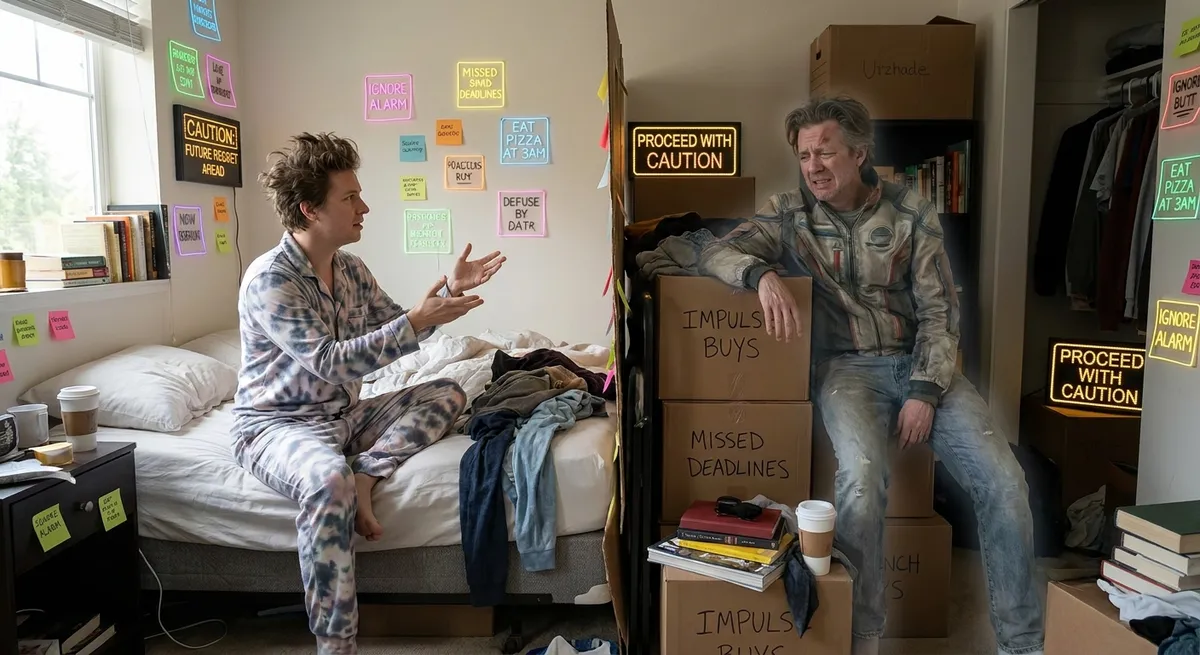
Your biggest enemy isn’t your boss, your ex, or the economy.
It’s your future self—the chaotic goblin who stays up till 2 a.m., ignores the laundry, forgets bills, and then shows up like, “Wow, why is life so hard?”
This is a guide to tricking that future goblin into accidentally living a better life. No “rise at 5 a.m. and grind” nonsense—just sneaky, low-friction hacks that make everything feel easier, funnier, and slightly less on fire.
The 2-Minute Cloak Of Laziness: Make Tasks So Tiny You Can’t Refuse
Your brain hates “big” tasks. “Clean the kitchen” feels like climbing Mount Doom. “Pick up three things” feels… doable.
So you don’t “clean your room.” You:
- Throw away three obvious pieces of trash
- Put one thing where it actually belongs
- Wipe one surface that looks like it’s seen some things
That’s it. That’s the hack: lie to your brain.
Why this works:
- Your brain is allergic to vague effort (“get organized”), but loves very specific, stupidly small missions.
- Once you start, your brain hates stopping mid-task. You’ll often keep going accidentally.
- Even if you don’t keep going, you still did three things, which is mathematically more than zero.
- Post a story: “Today’s 2-minute mission: put 5 random items back where they belong. Your turn.”
- Challenge a friend: loser buys snacks, winner chooses the movie. Everyone’s house is less tragic.
Turn it into a shareable game:
You’re not “becoming disciplined.” You’re just quietly tricking your brain like it’s a very polite raccoon.
Pre-Lazy Mode: Do Tiny Favors For Tomorrow You
Tomorrow You is a raccoon in a human suit. Never give them full responsibility.
Instead, do pre-lazy setup:
- Plug in your devices whenever you walk past a charger, even if they’re at 40–60%. That’s future-proofing your chaos.
- Put your “leaving the house” stuff (keys, wallet, headphones, emotional stability) in one “launch pad” spot near the door.
- If you cook, make slightly more and put it straight into containers. Call it “meal prep” and Instagram it like you intended this.
- Put meds, vitamins, or anything important next to something you actually use daily (coffee maker, computer, toothbrush). Make it impossible to ignore.
This works because you’re using your current burst of semi-functionality to protect your future half-asleep self.
Make it shareable:
- Before-bed story: post your “launch pad” pic with the caption, “Doing a favor for Tomorrow Me (who is unreliable at best).”
- Ask followers: “What’s one tiny thing you can set up right now that makes tomorrow easier?” The comments become more hacks you can steal.
You are not “getting your life together.” You are future-proofing your own incompetence. Which is honestly more realistic.
Turn Your Brain Into A Goldfish: The One-Tab, One-Task Rule
Your browser is a museum of past lives: 43 tabs, 8 half-read articles, 3 shopping carts, and that one Google search: “is it bad if caffeine makes my soul vibrate.”
Every tab is a tiny open loop screaming for attention. Your solution:
One task, one tab.
- Need to pay a bill? Open only that site. Pay it. Close.
- Need to book an appointment? Only that tab. Book it. Close.
- Need to look something up? Search. Get answer. Close. Flee.
- Email interesting links to yourself with a subject like “Read Later: Stuff You’ll Definitely Ignore.”
- Use a read-later app (like Pocket or your browser’s built-in “Reading List”).
- Or be brutally honest: if you won’t read it in the next 24 hours, let it go. If it’s important, you’ll Google it again.
- Everyone is a browser-tab hoarder. It’s universal chaos.
- Post a screenshot of your absurd number of tabs and challenge your friends: “One-task, one-tab week. Who’s in?”
- Run a poll: “How many tabs do you have open right now?” The answers will be either comforting or terrifying.
To save stuff without hoarding tabs:
Why people will share this:
Think of it as brain decluttering for people who will never, ever declutter their closets.
Default Decisions: Make The Choice Before The Chaos Hits
When you’re tired, stressed, or emotionally unstable because someone used “per my last email” on you, you will not make good decisions.
So take important choices and turn them into defaults while you’re calm(ish):
- Default meal: pick one “I’m too tired to think” meal that’s cheap, fast, and not entirely made of sugar. Keep the ingredients always on standby.
- Default bedtime: not “9 p.m. sharp,” just a “no new episodes after midnight” rule. You can doomscroll, but no starting a new 10-episode saga.
- Default spending rule: for non-urgent purchases, wait 24 hours. If you still want butterfly-shaped LED coasters tomorrow, go for it.
- Default plan for small crises: “If I panic, I take three deep breaths, drink water, step outside, THEN decide.”
- They remove the need for willpower in the moment.
- You’re following a script instead of wrestling your tired brain.
- You avoid “decision fatigue,” which is the fancy science way of saying “I ordered takeout 4 times this week.”
- Post one of your defaults: “New rule: I’m only allowed to buy something if Future Me can remember why in 24 hours.”
- Ask your followers: “What’s one default rule that saves your chaos life?”
Default decisions work because:
Make it social:
You’re not “becoming a better person.” You’re making a menu of options so even Disaster You can’t mess it up too badly.
The 5-Word Social Hack: Make People Actually Want You Around
Life hack: being even slightly better at human interaction is a cheat code. You don’t need charisma. You need five-word superpowers.
Try these:
- “Tell me more about that.”
- Use when someone’s excited about something. They’ll do 90% of the talking, and you’ll look incredibly thoughtful.
- “That sounds really hard, honestly.”
- Validation without advice. People love this way more than “Have you tried waking up earlier?”
- “I’m glad you told me.”
- Elite sentence. Makes people feel safe, seen, and less weird.
“What would make this easier?”
- Helps friends (or you) switch from spiraling to problem-solving without sounding like a motivational poster.
“Want hype or solutions first?”
- Ask this before you respond to someone venting. Sometimes they just want “that sucks,” not a TED Talk.
Why this spreads:
Share it:
You’re not turning into a therapist. You’re just installing a human-connection DLC pack.
Conclusion
You don’t need a 37-step morning routine, a productivity app that looks like a spaceship, or a personality transplant.
You need:
- Stupidly tiny tasks your brain can’t say no to
- Small favors for Tomorrow You, the walking disaster
- Less tab chaos so your brain can breathe
- Default decisions that babysit you when you’re tired
- A handful of magic sentences that make people feel like you “get it”
Your life doesn’t have to become perfect.
It just has to become 10% less annoying.
And that? Is extremely doable.
Now send this to a friend who is currently being bullied by their own future self.
Sources
- American Psychological Association – Why your brain resists big tasks - Explains motivation, goal-setting, and why smaller goals are more effective
- Harvard Business Review – Decision fatigue is real - Discusses how making too many decisions drains willpower and how to use defaults
- Cleveland Clinic – Multitasking and your brain - Details how task-switching and mental overload reduce productivity
- Mayo Clinic – Sleep and self-control - Shows how lack of sleep affects decision-making and daily functioning
- Greater Good Science Center (UC Berkeley) – The power of active listening - Covers why listening phrases and validation improve relationships