
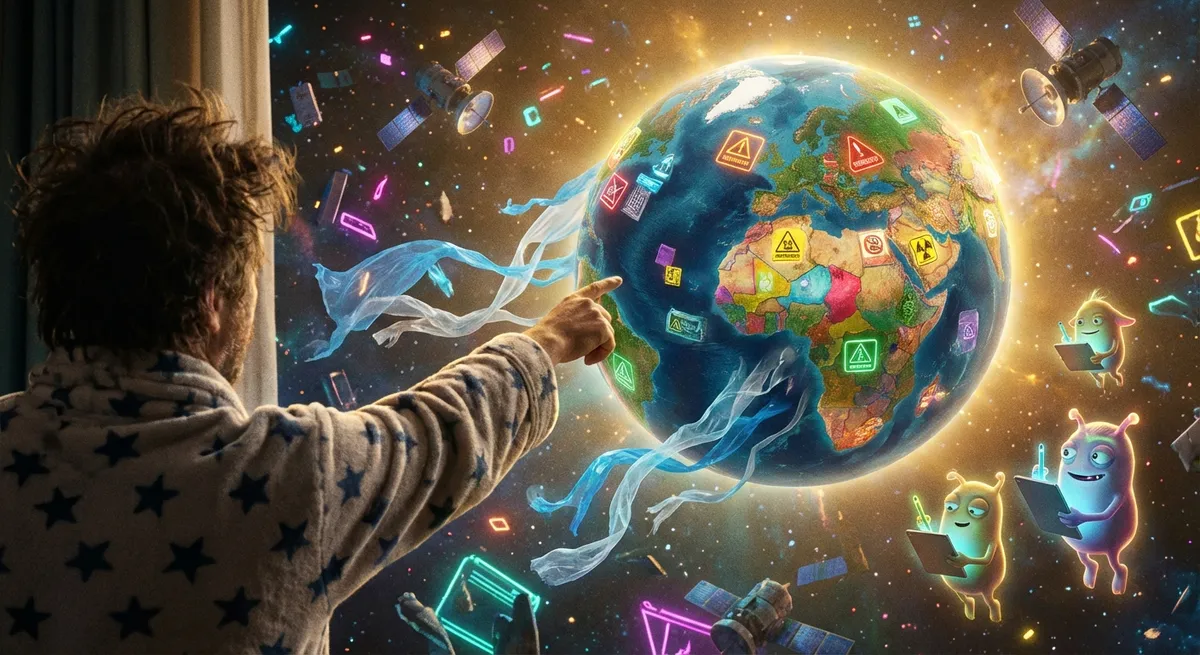
If Earth were a person, it would absolutely be “that friend” who swears they’re fine while actively catching on fire, spinning 1,000 mph, and yelling about molten iron. Somehow, the universe handed us this chaos marble and said, “Here, try not to drop it.”
This is your backstage pass to some of the weirdest, rudest, and most delightfully unhinged facts about the planet and reality you’re currently standing in. Screenshot bait? Yes. Group chat ammunition? Also yes.
Let’s unpack the nonsense.
The Moon Is Slowly Leaving Us Like It’s Done With This Relationship
The Moon, our loyal night light, is ghosting us in extreme slow motion.
Right now, the Moon is drifting away from Earth at about 3.8 centimeters per year. That’s roughly the speed your motivation leaves your body after opening a spreadsheet. In 50 million years, it’ll be so far away that total solar eclipses won’t work the same—no more perfect “circle cut out of the Sun” vibes, just awkward, off-center emo lighting.
This lunar breakup is happening because of tides. The Moon’s gravity drags our oceans around, and Earth’s rotation pushes back, flinging a bit of angular momentum at the Moon like, “Fine, leave then.” The Moon responds by slowly yeeting itself into a larger orbit.
Long-term, this means days on Earth are getting longer. Hundreds of millions of years ago, a “day” was closer to 21 hours. Imagine fitting a whole extra Netflix episode in every day by default. Evolution truly fumbled the bag on that one.
So yes, we are living on a planet in a codependent gravitational relationship where one partner is quietly walking backward out of frame—and everyone’s just pretending that’s normal.
You’re Already A Time Traveler, Just Not The Cool Kind
You are technically time traveling right now—Einstein would absolutely back you up on this—but in the most boring way possible.
According to relativity, time doesn’t tick at the same speed everywhere. The faster you move or the stronger gravity is, the slower your time runs compared to someone else’s. This isn’t sci-fi fanfic; GPS satellites literally have to adjust their clocks because they experience time slightly differently than people on Earth. If they didn’t, your maps app would be wrong by several kilometers per day, and you’d end up “arriving at your destination” in a lake.
Also, your head is aging slightly faster than your feet because it’s further from the center of Earth’s gravity. The difference is tiny—nanoseconds—but technically, your face is older than your toes. So if you’ve ever thought, “Wow, I look tired,” congrats, that’s accurate physics.
You’ve also already time traveled into the future just by existing: every second that passes is you moving one second forward in time. Not glamorous. No DeLorean. Just taxes and emails.
But if you want to feel dramatic, lean into it: “Sorry I’m late, I was time-dilating in a weaker gravitational potential.” No one will understand, but they also can’t say you’re wrong.
Bananas Are Radioactive, And So Are You (Politely)
Bananas are radioactive. Mildly. Casually. Nothing-to-see-here-please-keep-peeling-level radioactive.
They contain potassium-40, a naturally occurring radioactive isotope. It’s so normal that radiation safety folks literally invented a unit called the “banana equivalent dose” to explain how not-scary some exposures are. If someone says, “That scan was like eating a couple of bananas,” that’s science-speak for “You’re fine, go home.”
The real plot twist: your body is also naturally radioactive. You’ve got carbon-14 and potassium-40 inside you right now, humming along like a low-budget nuclear plant that just wants you to keep living. If you hug someone, your atoms are technically hitting them with the tiniest sprinkle of radiation—romantic, in a vaguely horrifying way.
If that sounds alarming, remember: humans evolved in this environment. The universe basically said, “The floor is radiation,” and biology went, “Cool, we’ll just vibe.” Every cell in your body is used to this background chaos.
So yes, you are a softly glowing bag of atoms eating slightly glowier fruit while standing on a radioactive rock circling a giant nuclear fireball. Cozy.
You Have More Alien DNA Neighbors Than Human Ones
If your body were a city, humans would be the tourists. The real residents? Bacteria, viruses, fungi, and microscopic chaos gremlins.
Your body is home to trillions of microbes—on your skin, in your gut, in your mouth, everywhere. By cell count, you are roughly as much microbe as you are human. Some estimates used to say you were 90% non-human cells; newer data suggests it’s closer to a 1:1 ratio, but the point still stands: you’re a walking, talking apartment complex.
Your gut microbiome helps digest food, trains your immune system, and may even influence your mood and behavior. This means at least part of your personality is co-written by gut bacteria, which explains every chaotic food decision you’ve ever made at 2 a.m.
Some viral DNA has been stitched into your genome over millions of years. That’s right: ancient viruses basically left “You up?” messages in our DNA, and evolution said, “Yeah, sure, we can use that.” One of the genes crucial for forming the placenta in mammals likely came from an ancient virus. So if you’re here because your ancestors successfully reproduced, thank a very distant viral intruder.
You are not a single organism. You’re a group project pretending to be one person—and somehow, it’s going better than most actual group projects.
The Sun Is So Loud It Would Vaporize Your Eardrums (If Space Had Sound)
The Sun is not a calm, peaceful golden orb. It is a screaming nuclear inferno that only looks soft because it’s far away and Instagram-filtered by the atmosphere.
If space could carry sound the way air does, the Sun’s surface would be unimaginably loud—estimates go up to about 100–120 decibels millions of miles away. That’s like living next door to a stadium concert that never ends, except the band is made of plasma and hates you.
The Sun constantly roils with convection cells, eruptions, and shock waves that would create booming acoustic waves in a medium. On Earth, we hear tiny echoes of its tantrums as changes in the ionosphere and geomagnetic storms, which can mess with satellites, power grids, and occasionally your ability to doomscroll in peace.
Solar flares and coronal mass ejections can fling charged particles at Earth, lighting up the sky with auroras. Those pretty northern lights? That’s our magnetic field getting absolutely punched in the face by solar chaos and turning it into vibes.
So when you look up at the sky on a sunny day, just know: that warm, gentle glow is coming from a gigantic, shrieking ball of nuclear rage that will eventually expand and vaporize everything you’ve ever loved. Happy sunscreen season!
Conclusion
You are currently:
- Riding a spinning rock
- Slowly abandoned by its Moon
- Time-warping by existing
- Mildly radioactive
- Co-authored by bacteria
- Orbiting a screaming star
And somehow your biggest stress today is probably an unread email or someone typing “k.” in a text.
Reality is so much weirder than we’re taught, and honestly, it kind of slaps. So the next time life feels boring, remember: you are a time-dilated microbial space cryptid holding a radioactive fruit while your star yells at the void.
Maybe screenshot that sentence. The group chat deserves to suffer with you.
Sources
- [NASA – The Moon Is Drifting Away from Earth](https://moon.nasa.gov/resources/438/the-moon-is-drifting-away-from-earth/) - Explains how and why the Moon is gradually moving farther from Earth
- [NASA – Relativity, GPS, and Time Dilation](https://www.nasa.gov/centers/goddard/news/topstory/2003/0210gps.html) - Describes how Einstein’s relativity affects GPS satellite clocks and time
- [U.S. NRC – “Fact Sheet on Background Radiation”](https://www.nrc.gov/reading-rm/doc-collections/fact-sheets/background-radiation.html) - Covers natural sources of radiation, including foods like bananas and the human body
- [NIH – The Human Microbiome](https://www.ncbi.nlm.nih.gov/pmc/articles/PMC3535073/) - Scientific overview of the trillions of microbes that live in and on the human body
- [NASA – The Dynamic Sun](https://solarsystem.nasa.gov/solar-system/sun/overview/) - Details the Sun’s turbulent behavior, solar flares, and impacts on Earth