
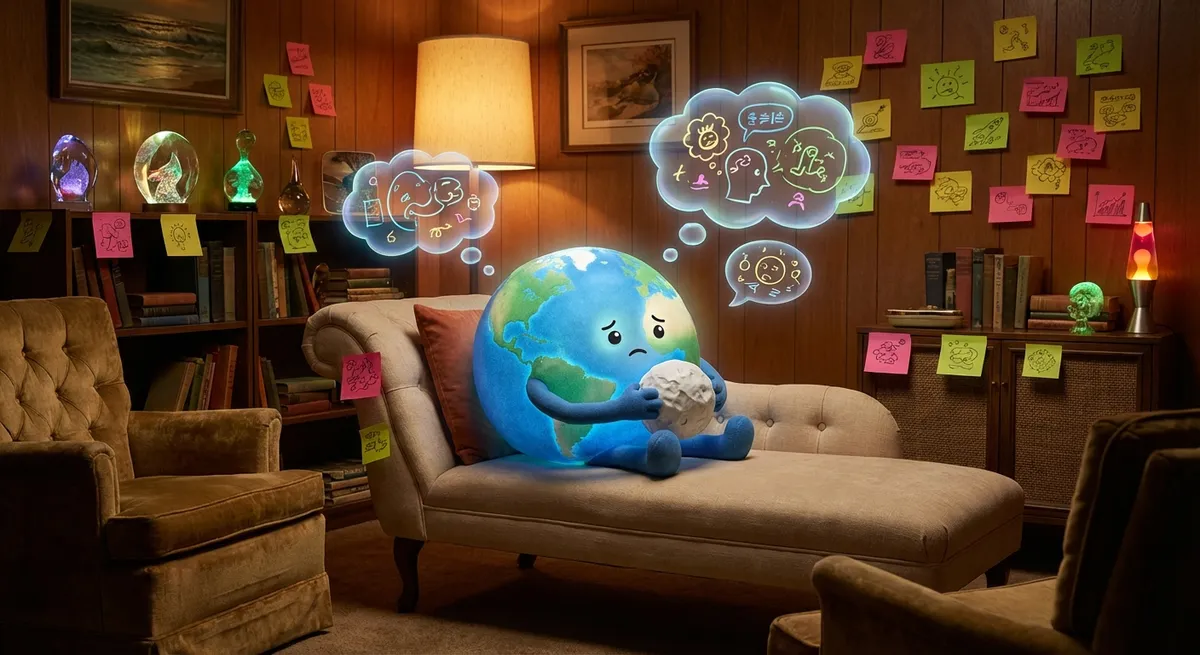
Earth looks normal from space, but up close it’s giving serious “developer left in a test build” energy. The oceans are glitchy, animals are suspiciously talented, and somewhere in Australia a lake is pink for no good reason except “science, probably.”
Here are five real facts about our planet that sound like they were brainstormed by an overcaffeinated writer’s room. Yes, they’re all true. No, reality does not need a sequel—this one is already too much.
The Ocean Is Hiding a Waterfall Bigger Than Any on Land
Plot twist: the world’s biggest waterfall is underwater where no one can see it. Classic ocean behavior.
Between Greenland and Iceland, there’s something called the Denmark Strait cataract, which is basically a mega‑waterfall made of cold, heavy water plunging under warmer water. The “drop” is about 3,500 meters (11,500 feet)—that’s roughly three times the height of Angel Falls, the tallest waterfall on land. You’d expect at least a tourist center and one guy selling fridge magnets, but nope. Just darkness, crushing pressure, and water doing parkour.
This underwater juggernaut moves an estimated 5 million cubic meters of water per second. Imagine 2,000 Olympic swimming pools yeeted over a cliff every second. The only reason this doesn’t show up on postcards is that humans are deeply shallow and like things we can see without a submarine and a PhD.
If the ocean is hiding something this dramatic, there is absolutely no telling what it’s doing with all those shipwrecks, cables, and that one sandal you lost in 2011.
There’s a Pink Lake in Australia That Looks Photoshopped (But Isn’t)
Australia looked at normal blue water and said, “Nah, let’s make it bubblegum.”
Lake Hillier, off the coast of Western Australia, is naturally bright pink. Like, cartoon‑princess‑bedroom pink. From above, it looks like someone spilled Pepto‑Bismol on Google Maps. And despite the color, it’s totally real and not the result of someone putting Instagram filters on the entire continent.
The color comes from microorganisms like Dunaliella salina and certain halophilic (salt‑loving) bacteria that produce red or pink pigments in super‑salty water. The wild part? If you scoop the water into a container, it still stays pink. This is not a lighting trick. This is not AI. This is nature absolutely flexing.
The lake is so salty that it makes the ocean look like a lightly flavored beverage. It’s not exactly a casual swim spot—more like “giant biological witch’s brew, do not drink, do not fall in, do take aerial photos and panic your followers.”
If Earth has a default color palette, Australia clearly downloaded the DLC.
Spiders Can Yeet Themselves Across Continents Using Static Electricity
Spiders took one look at the laws of physics and thought: “These are guidelines.”
Many spiders, especially tiny ones, use a trick called ballooning to travel. They climb to a high point, lift their little spider butts, release silk into the air, and—if conditions are right—get lifted off the ground and carried away. People used to think it was just wind. Cool, simple, harmless.
Then scientists discovered that spiders can also sense and use Earth’s electric fields to boost this process. The planet’s atmosphere is slightly charged, and spider silk can respond to that electricity. When the electric field is strong enough, the silk lifts and pulls the spider with it—like nature’s cursed hot‑air balloon.
Spiders have been found kilometers up in the air and can land hundreds of miles from where they started. So while we’re out here complaining about airline baggage fees, spiders are straight‑up hitchhiking the ionosphere, no passport, no carry‑on, just vibes.
If you’ve ever been minding your business and suddenly found a spider in your house, yes, there is a nonzero chance it paraglided from the sky using electric fields like a tiny goth wizard.
You (Yes, You) Are Slightly Younger Than Your Own Head
Time is fake and also petty.
Because of gravity, time doesn’t pass at the exact same speed everywhere. This is called gravitational time dilation, and while it sounds like sci‑fi, it’s a real thing measured by very precise atomic clocks. The closer you are to the center of Earth (stronger gravity), the slower time moves. The farther away you are, the faster it moves.
Your feet are closer to the center of Earth than your head. That means time is ticking ever so slightly slower at your feet. Over your lifetime, your head has experienced more time than your toes. So technically, your head is older than your feet, and your whole body is very slightly younger than it would be if you spent your life on the roof instead of the ground.
The effect is tiny—like nanoseconds. But real. So when someone says “age is just a number,” you can reply: “Actually, it’s a number fuzzed by relativistic effects due to gravitational potential,” and then enjoy the silence as they reconsider inviting you to things.
Congratulations: you’re a walking time glitch. Just not enough to skip Monday.
There’s a Place on Earth Where Rocks Move Themselves (Slowly. Menacingly.)
In California’s Death Valley, there’s a dry lakebed called Racetrack Playa where rocks appear to mysteriously slide across the ground, leaving long tracks in the mud. For decades, no one could figure it out. Theories included:
- Ghosts
- Aliens
- Secret pranksters with nothing better to do
The truth is weirder and somehow more satisfying. Researchers eventually discovered that in just‑right conditions, a thin layer of water freezes into sheets of ice, trapping rocks. When the sun warms things up, the ice breaks apart and, with a little breeze, the rocks slowly skid across the muddy surface, pushed by floating ice panels like creepy geological Roombas.
The movement is so slow and subtle that you’d never catch it in real time without special cameras. One moment the rocks are vibing. Some days or weeks later, you come back and bam: long drag marks across the clay and rocks sitting somewhere new like they got up in the night for a snack.
So yes, Earth has a natural “possessed rock simulator,” and no, it didn’t tell anyone about it for most of modern human history.
Conclusion
Earth absolutely did not need to go this hard, and yet here we are:
- An underwater waterfall bigger than anything above water
- A bubblegum‑pink lake that looks like Photoshop threw up
- Spiders surfing the sky using electricity
- Your own body being a tiny time‑travel experiment
- Rocks silently scooting across a desert like haunted furniture
If this is the “normal” background setting for daily life, imagine what else is out there that we haven’t noticed because we’re too busy refreshing notifications.
Share this with someone who thinks reality is boring. Then stare at the ground, the sky, and a random spider and admit: yeah, this planet is running some seriously unhinged side quests.
Sources
- [National Oceanic and Atmospheric Administration (NOAA) – Denmark Strait Cataract](https://www.noaa.gov/education/resource-collections/ocean-coasts/ocean-currents#denmark) – Overview of the massive underwater waterfall and how density differences drive it
- [Australian Geographic – Lake Hillier’s Pink Mystery](https://www.australiangeographic.com.au/topics/science-environment/2012/06/why-is-lake-hillier-in-western-australia-pink/) – Explains the microorganisms and salinity behind the lake’s bubblegum color
- [National Geographic – Ballooning Spiders](https://www.nationalgeographic.com/science/article/spiders-fly-electric-fields-ballooning) – Details how spiders use wind and electric fields to travel long distances
- [NASA – General Relativity and Time Dilation](https://www.nasa.gov/mission_pages/gpb/relativity.html) – Describes how gravity affects the passage of time and why clocks at different heights tick differently
- [Scripps Institution of Oceanography – Sliding Rocks of Racetrack Playa](https://scripps.ucsd.edu/news/scientists-solve-mystery-slithering-stones-death-valley) – Research article explaining how ice, water, and wind move rocks across the desert floor