
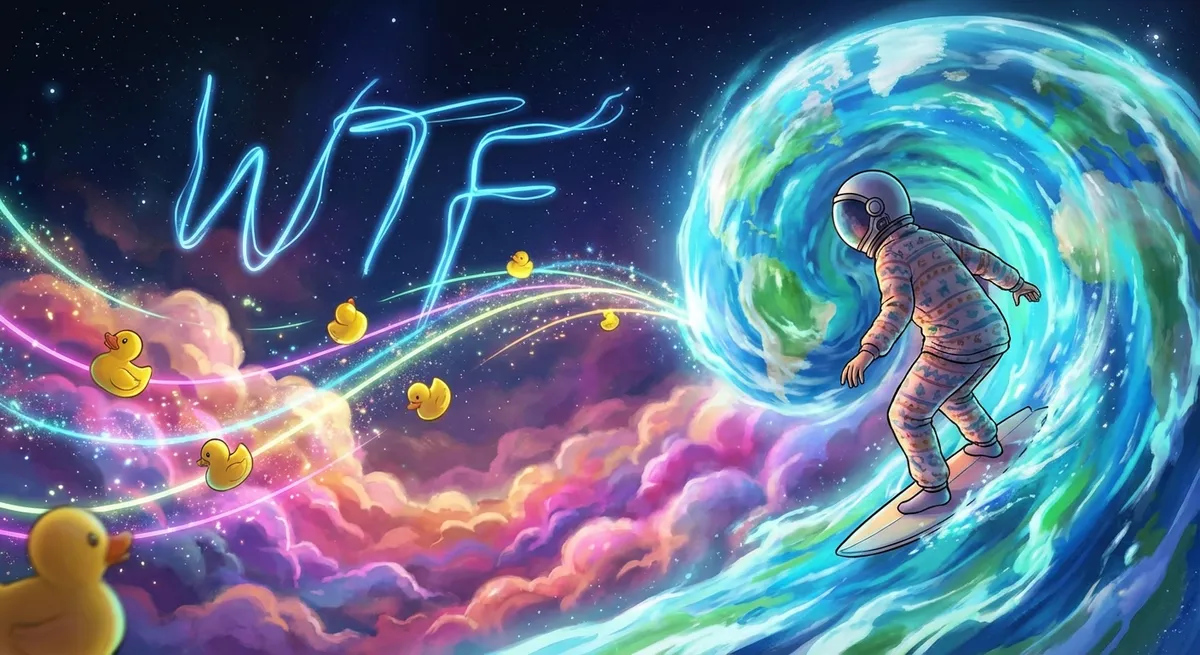
Earth looks chill from space—blue, round, allegedly “normal.”
But zoom in and it’s basically a group project run by caffeine, volcanoes, and confused animals.
Welcome to the weird side of reality: verified, science-backed facts that sound like shower thoughts written by a raccoon with Wi‑Fi. These are the kind of “Wait, WHAT?!” nuggets you drop in a group chat and then silently watch everyone spiral.
Let’s ruin your sense of normal in a fun way.
The Ocean Is Hiding a Giant “Waterfall” That No One Can See
Somewhere between Greenland and Iceland, the ocean is casually doing parkour.
Under the surface, there’s something called the Denmark Strait cataract, which is basically a gigantic underwater waterfall—like, world-record gigantic. Cold, dense water from the Nordic seas sinks and plunges beneath warmer water from the Irminger Sea, creating a downward flow estimated at over 3 million cubic meters of water per second. That’s more than 2,000 times the flow of Niagara Falls, just… invisible.
So yes, planet Earth has:
- A secret mega-waterfall you’ll never see
- A dramatic cold-water flex that drives part of the global ocean circulation
- A built-in feature that sounds like a fantasy RPG dungeon but is very much in your geography textbook
The best part? If this system changes too much (thanks, climate change), it could mess with ocean currents and weather patterns. Translation: the planet’s hidden plumbing is part of the reason your weather app is wrong… but not that wrong.
Share this with someone who thinks “underwater waterfall” sounds fake. Then send them the satellite data.
Bananas Are Radioactive and We Just… Eat Them Anyway
Bananas: yellow, tasty, and very slightly radioactive. Yes, that’s a sentence you just read.
They contain potassium-40, a naturally occurring radioactive isotope. It’s harmless in normal amounts, but technically, if you measure radiation exposure in units called banana equivalent dose (this is a real thing scientists jokingly use), eating a banana gives you a tiny, measurable dose of radiation.
Important clarifications before you cancel smoothies:
- You’d need to eat millions of bananas at once to get a dangerous dose.
- At that point, the potassium overload would be the problem, not the radiation.
- The human body already contains radioactive isotopes—congrats, you are a soft, walking science experiment.
Scientists sometimes use bananas in public outreach to explain how low-level radiation works because people accept bananas but not scary words like “radiation.” Basically, you’ve been snacking on tiny nuclear vibes your whole life and calling it breakfast.
Next time someone says, “I’m trying to be healthier,” you can reply, “Same, I’m microdosing radiation with fruit.”
Tardigrades Are Basically Tiny Immortal Goblins
If there’s anything on Earth that will survive the apocalypse, it’s not cockroaches. It’s tardigrades—tiny, eight-legged micro-cryptids that look like gummy bears with a tax audit.
Tardigrades (aka water bears) can:
- Survive being frozen close to absolute zero
- Tank temperatures over 300°F (149°C)
- Handle pressure higher than the deepest ocean trenches
- Chill in the vacuum of space like it’s a casual afternoon in the park
- Go without food or water for decades by drying out into a “tun” state and then reanimating when things get moist again (yes, science chose that word)
They achieve this by basically turning themselves into a microscopic raisin: their metabolism slows to nearly zero, DNA gets wrapped in protective proteins, and they wait out the chaos like the universe is buffering.
Scientists even accidentally launched them into space on purpose to see what would happen. What happened: they lived. No suit, no helmet, just pure disrespect for physics.
Humans: “We need billion-dollar tech to go to space for 3 minutes.”
Tardigrades: “I packed vibes and resilience. I’m good.”
Bees Can Recognize Human Faces and Might Remember You
You know how people say, “Don’t bother the bees, they’re more scared of you than you are of them”? Yeah, about that.
Honeybees and some other bee species can actually recognize and remember human faces—using a pattern recognition process similar to how we do it. In experiments, bees were trained with sugar water to associate specific human faces with rewards. They then picked out those same faces from lineups like tiny, flying detectives.
What this means:
- Bees don’t just see us as vague giant blobs of threat; they can tell individuals apart.
- They can be trained to associate certain faces with good or bad experiences.
- Your local bees may or may not have opinions about you.
Also, bees communicate through waggle dances that encode direction and distance of flowers using the sun as a reference. So yes, there are insects out there doing interpretive GPS ballet while also possibly remembering that you once panicked and flailed at them with a shoe.
Be nice to bees. They pollinate your food, decode geometry, and might be silently judging your vibe.
Thunder Can Be Hotter Than the Surface of the Sun (Briefly, Somehow)
Lightning is the flashy one, but thunder is the chaos that follows.
When lightning strikes, that bolt of electricity superheats the surrounding air to around 30,000°C (54,000°F)—that’s about five times hotter than the surface of the Sun. The air expands so fast it creates a shock wave we hear as thunder, like the sky tearing reality a little.
The timeline, roughly:
- Cloud throws electric tantrum.
- Nearby air gets yeeted into “pls no” temperature territory.
- Air expands violently → shock wave → thunder.
- You jump, pretend you weren’t scared, and check your phone for the storm radar.
Meanwhile, we just stand here on a rock in space where invisible atmospheric charge builds up, snaps, and casually produces sun-level heat above our heads—and we call it “weather.”
Next time thunder claps and your whole house shakes, remember: the atmosphere just briefly achieved cosmic-level heat and decided to scream about it.
Conclusion
Earth is not a “normal” planet. It’s a chaos simulator where:
- Invisible underwater waterfalls yeet oceans around
- Breakfast is very slowly radioactive
- Tiny space-proof goblins nap through doomsday
- Bees have facial recognition and dance-based GPS
- The sky occasionally heats up hotter than the Sun and shouts
Yet somehow, in the middle of all this, our biggest daily crisis is losing our charger.
Share this with someone who thinks life is boring. The planet is out here doing boss battles while we argue about Wi‑Fi.
Sources
- [National Oceanic and Atmospheric Administration – Denmark Strait Cataract](https://oceanservice.noaa.gov/facts/denmark-strait.html) - Explains the massive underwater waterfall between Greenland and Iceland
- [U.S. Nuclear Regulatory Commission – Fact Sheet on Potassium Iodide](https://www.nrc.gov/about-nrc/radiation/protects-you/protection-kid.html) - Includes discussion of natural potassium-40 and everyday radiation exposure
- [NASA – Tardigrades in Space](https://www.nasa.gov/centers/ames/news/releases/2011/11-79AR.html) - Describes experiments sending tardigrades into space and their survival
- [Cambridge University – Bee Facial Recognition Research](https://www.cam.ac.uk/research/news/honeybees-can-recognise-human-faces-say-scientists) - Details experiments showing bees can recognize human faces
- [National Weather Service – Lightning FAQ](https://www.weather.gov/safety/lightning-science-temp) - Covers lightning science, including temperatures hotter than the Sun