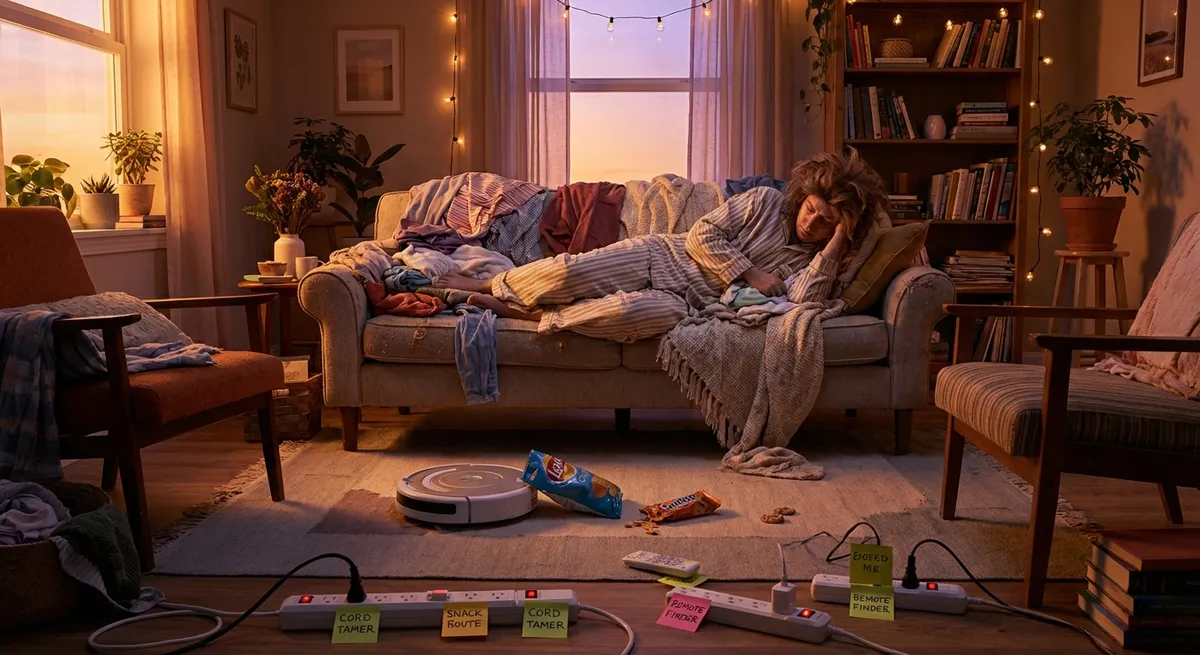
If you’ve ever stared at a pile of laundry and thought, “If I ignore this long enough, it evolves into a different problem,” welcome home. This is your guide to looking suspiciously functional while doing the absolute minimum the universe will let you get away with.
These aren’t your usual “drink water” and “wake up at 5 a.m.” tips. This is about hacking your environment, your brain, and your daily chaos so that Future You stops sending angry emails to Past You.
Share this with a friend who insists they’re a “messy creative” but is actually just… messy.
1. The “Friction Hack”: Make the Easy Thing the Right Thing
Your brain is lazy. That’s not an insult; that’s a feature. It loves whatever has the least friction—so instead of trying to change your willpower, change the path of least resistance.
Put the good snacks at eye level and the chaos snacks in a cabinet that squeaks like a haunted door. Keep your water bottle literally where your phone usually lives so you have to touch hydration before you touch social media. Want to read more? Lay your book on your pillow after you make your bed so Netflix has to physically fight for custody of your attention at night.
On the flip side, increase friction for habits you hate: log out of apps that eat your time, store your gaming controller in your backpack, or put your credit card in a coat pocket in the closet so impulse buys require a side quest. You’re not becoming a better person; you’re just booby-trapping your own laziness in your favor.
2. The “Batching Your Chaos” Rule: Group Tiny Tasks Like a Netflix Season
Your brain hates task-switching more than it hates low battery mode in public. Every time you jump from “answer this text” to “wash a dish” to “check email” to “research why crows remember faces,” your mental energy takes a hit.
Instead, group your chaos into little themed episodes. Have a “Phone Goblin Time” where you respond to messages, DMs, and emails in one blast while you sit, scroll, and question your life choices. Then have a “Gremlin Chores Window” where you do just five-to-ten-minute tasks: wipe counters, take out trash, load the dishwasher, move laundry one stage forward in its never-ending hero’s journey.
Batch your errands on one day if possible—post office, groceries, returns. You’ll save time, gas, and emotional bandwidth. Think of your day like a streaming service: seasons and episodes, not 73 random shows playing at once in your brain’s browser tabs.
3. The “Default Settings” Trick: Automate Your Bare Minimum
The most powerful life hack isn’t motivation; it’s automation. If you set decent default settings, your life quietly upgrades even when you’re running on 3 hours of sleep and vibes.
Set up automatic transfers: a tiny amount to savings every time you get paid—even the “I am but a humble raccoon” amount matters. Put boring-but-important bills (phone, internet, utilities) on auto-pay if you safely can, so Past You saves Future You from Late Fee Apocalypse. Use calendar reminders that repeat weekly for the stuff you swear you’ll “remember this time.” You will not. Let the calendar bully you gently.
You can create default “go-to” options for your most chaotic decisions: one easy breakfast you can make half-asleep, a default “I have 7 minutes” workout, and a standard “quick clean” checklist for when people text “omw” and your home currently looks like an emotional support tornado. Default settings are how you look like you know what you’re doing when you really, really don’t.
4. The “Visible Progress” Cheat: Trick Your Brain With Tiny Wins
Your brain loves visible proof that it did something. Not “felt stressed,” not “thought about doing it,” but actual, physical, “look what I did” evidence. Use that to lure it into productivity like a raccoon with shiny objects.
Instead of “clean the whole room,” try “make the bed” first—instant visual upgrade. Clear just one surface: your desk, coffee table, or kitchen counter. That mini before-and-after hits your brain’s reward center and makes the next step slightly less miserable. Use checklists with aggressively tiny tasks like “open laptop,” “reply to 1 email,” “move laundry to dryer.” Yes, it feels silly. No, your dopamine does not care.
If you’re working on something long-term—studying, learning a skill, building a project—track it where you can literally see it: a wall calendar with Xs, a habit app, or a sticky note army. The goal is to make your progress louder than your self-doubt, which is already on max volume with studio headphones.
5. The “One Decision, Many Wins” Strategy: Stack Benefits Like a Greedy Goblin
Some tasks are annoying, but if you choose them carefully, one action can give you multiple wins. That’s peak lazy genius: maximum payoff, minimum effort.
Walk to get your coffee instead of driving? That’s movement, sunlight, and caffeine in one errand. Call a friend while you do dishes? Social connection plus clean forks. Meal-prepping anything—even chaotic “food that goes with hot sauce”—saves future time, money, and brainpower. Put a pull-up bar or yoga mat in your most annoying traffic zone at home so you literally trip over healthy choices.
Look for moves that fix more than one problem at once: a 10-minute tidy with music = mood booster, light exercise, and less visual stress. Reading on your phone outside instead of inside = screen time, but now with vitamin D and fewer crumbs in your bed. You’re still you; you’ve just learned to game the system like it’s a badly coded RPG.
Conclusion
You don’t need a full personality upgrade or a 4 a.m. cold plunge to get your life 12% more together. You just need to outsmart your environment, weaponize your laziness, and let tiny tweaks do the heavy lifting while you pretend to be “in your low-power era.”
Change the friction. Batch the chaos. Automate the basics. Celebrate tiny wins. Stack your actions.
Then sit back, sip your drink of choice, and enjoy the suspiciously functional version of your life that appears while you’re still very much you—just with fewer “HOW DID IT GET THIS BAD??” moments.
Send this to the friend whose life is a mess, but in a very lovable way.
Sources
- [American Psychological Association – Willpower and Self-Control](https://www.apa.org/helpcenter/willpower) – Explains why relying on willpower alone is exhausting and why changing your environment is more effective.
- [Harvard Business Review – How to Make Good Habits Stick](https://hbr.org/2021/02/how-to-make-good-habits-stick) – Covers habit formation, friction, and designing better defaults in daily life.
- [James Clear – The Scientific Argument for Mastering One Tiny Habit at a Time](https://jamesclear.com/one-small-step) – Discusses the power of small, visible wins and incremental progress.
- [National Institutes of Health – Cognitive Costs of Multitasking](https://www.ncbi.nlm.nih.gov/pmc/articles/PMC4171350/) – Research on why constant task-switching drains focus and productivity.
- [Mayo Clinic – Exercise: 7 Benefits of Regular Physical Activity](https://www.mayoclinic.org/healthy-lifestyle/fitness/in-depth/exercise/art-20048389) – Supports the idea of stacking benefits (e.g., walking for errands) for health and mood.