You know that point in adulting where you’re not a disaster, but also… if someone opened your browser history they’d see “how to boil eggs” next to “quantum physics for babies”? This article is for that exact energy.
These are not “wake up at 5 a.m. and run a marathon” life hacks. These are “I am barely functioning but somehow thriving in spite of myself” upgrades. The kind of tips you send to your group chat with: “This is unhinged but also genius??”
Let’s optimize your chaos.
1. The “Future Me Is a Victim” Rule
Here’s the honest truth: Present You is a menace. Present You will stay up too late, leave dishes for “later,” and put Important Documents somewhere “safe,” aka a folder you will never emotionally reconnect with.
So: treat Future You like a delicate Victorian child with a weak constitution.
Before you end a task, ask, “Will Future Me suffer because of this?” If yes, do the laziest possible version of fixing it now:
- Don’t clean the whole kitchen. Just make sure the sink is empty so Tomorrow You doesn’t wake up furious.
- Don’t organize your whole email. Just star the three emails that actually matter so Future You doesn’t spend 20 minutes rage-scrolling.
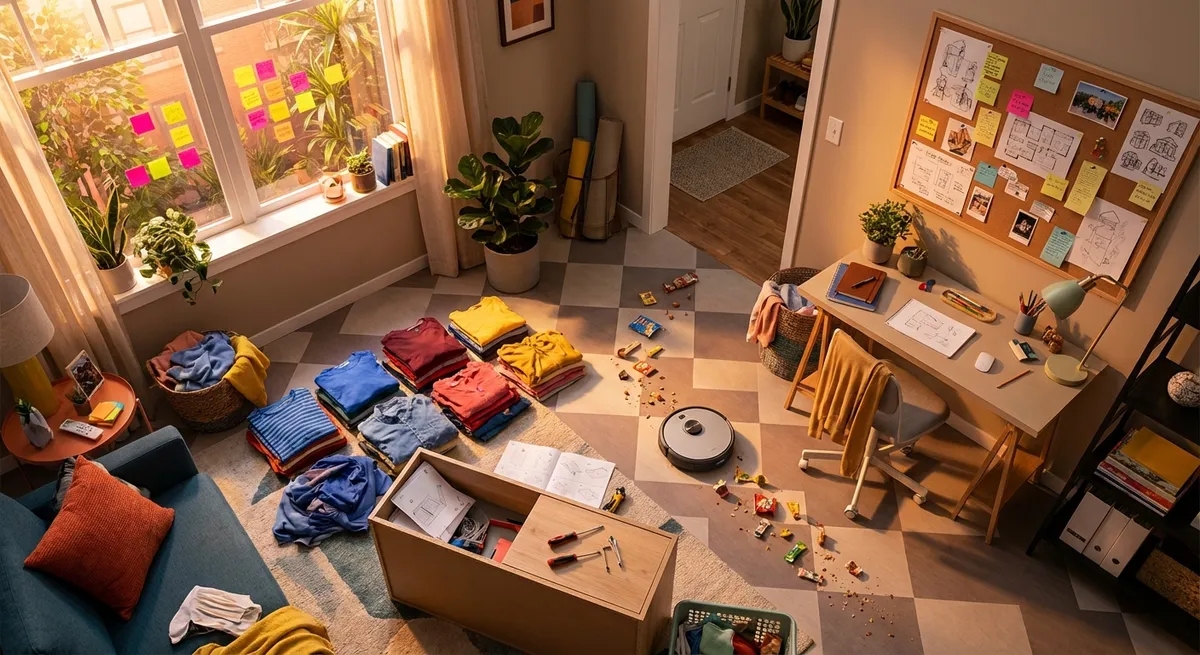
- Don’t fold your laundry. Designate one “acceptable chaos chair” specifically for clean clothes only—Future You just needs to know which pile won’t smell like regret.
This isn’t about perfection; it’s about reducing future suffering. Call it “micro-heroism.” Call it self-compassion. Call it “I refuse to be personally victimized by Yesterday Me ever again.”
Shareable angle: The moment you start narrating everything as “Will Future Me sue me for this?” you literally change your behavior. It’s like morally peer-pressuring yourself.
2. The “Default Setting” Cheat Code
Most people wildly overestimate willpower and wildly underestimate laziness. The truth: we are all just raccoons in people costumes, doing whatever is easiest in the moment.
So instead of trying to become a “disciplined person,” rig your default settings:
- Want to drink more water? Put a full glass next to whatever screen you stare at the most. Your brain: “Object near face? We consume.”
- Trying to read more? Move one book to the spot where your phone usually lives when you sit down. You will pick it up by accident at least 3 times a week, and that still counts.
- Hate cooking? Choose one “zero-brain” meal (e.g., frozen veggies + whatever protein + sauce) and keep it permanently stocked. This is your Panic Goblin Meal. You are not above the Panic Goblin Meal.
The hack: Don’t become a better person. Become a person for whom the easiest option is secretly the healthiest, cheapest, or least chaotic.
If life is a video game, “default setting” design is basically turning on casual mode.
Shareable angle: You don’t need more motivation—you need to booby-trap your life so that laziness works for you.
3. The 2-Minute Social Life Upgrade
“Maintaining friendships” sounds deep and emotional until you realize most of it is just… not disappearing into the void like a Victorian sea captain.
Enter: the 2-Minute Social Rule. If it takes under 2 minutes to send, you do it right now:
- See a meme that screams your friend’s name? Send it. No caption needed. The meme is the love language.
- Think of someone randomly? Voice note: “I just remembered the time you [insert chaotic memory] and I’m still not over it. That’s all. Goodbye.”
- Too tired to have an actual conversation? Hit them with: “Too brain-dead to talk, but I love you, this is a scheduled haunting.”
Tiny pings keep relationships alive without scheduling a “We Need To Catch Up Properly” call that neither of you emotionally survives.
Bonus hack: Create a “People I Actually Like” favorites list in your messages app so their names stay at the top. Out of sight = out of mind = “wait when did we last speak, the Obama administration??”
Shareable angle: Most people think they’re bad friends. They’re just bad at high-effort friendship. This is friendship on easy mode.
4. Turn Procrastination into a Side Quest System
Your brain doesn’t hate work; it hates the main quest. But it will happily do five other useful things while avoiding it. So let’s gamify that problem.
When you’re avoiding a Big Scary Task, open your Notes app and create a “Side Quest List”:
- “Don’t want to start report” → wash your face, reply to one email, take out trash.
- “Avoiding phone call” → clear 10 photos from camera roll, wipe desk, fill water bottle.
- “Stalling on assignment” → schedule one appointment, check bank balance, move laundry.
The only rule: if you’re procrastinating, pick a side quest from the list. You are allowed to avoid your main task—but you must level up something while you do it.
Congratulations, you’re now productively procrastinating. You look busy, you feel chaotic, but things… get done?
Warning: occasionally, by the time you’ve completed three side quests, your brain will be warmed up enough to attack the main quest. That’s accidental competence. Roll with it.
Shareable angle: This reframes procrastination from “I am a failure” to “I am a character in an RPG taking the scenic route.”
5. The “Visible Brain” System (For When Your Mind Is Just Static)
Your brain is not a filing cabinet. It’s a snow globe—pretty, chaotic, and entirely unreliable for storing information.
Stop trying to remember things. Make your environment do the remembering for you:
- Put your meds next to your toothbrush or coffee mug. If you forget both, we have bigger issues.
- Put your gym clothes on the chair or doorknob, not in a drawer. Annoy yourself into going.
- Keep a whiteboard or paper list in the exact spot your brain usually melts (desk, kitchen, next to bed). It is now your external brain. Raw, ugly to-do lists welcome.
“Out of sight, out of mind” is not a personality flaw; it’s just how human cognition works. Marketers know this. Supermarkets know this. You can use the same trick—just more ethically, hopefully.
Bonus: the “Launchpad Zone.” Designate one small area by your door for keys, wallet, headphones, work badge, etc. You are building a tiny airport for your daily takeoff. Every time you don’t panic-search for keys is minutes of life reclaimed from chaos.
Shareable angle: The problem isn’t your memory—it’s that you’re trying to store 10,000 tabs in your head instead of on a wall.
Conclusion
You do not need a full personality reboot to “fix your life.” You need tiny, slightly unhinged adjustments that respect the fact that you are:
Tired
Online too much
Doing your best, kind of
Treat Future You like a fragile princess. Rig your defaults. Send microscopic friendship pings. Turn procrastination into side quests. Externalize your brain onto walls, notes, and aggressively placed objects.
You don’t become a new person overnight— you just become 3% less chaotic, repeatedly. And that? Adds up to a quietly overpowered life.
Now go send this to a friend with the caption: “This is us but in a weirdly functional way.”
Sources
- [American Psychological Association – Procrastination Research](https://www.apa.org/news/press/releases/2010/04/procrastination) - Explains why we procrastinate and how “productive procrastination” can sometimes help.
- [Harvard Business Review – Manage Your Energy, Not Your Time](https://hbr.org/2007/10/manage-your-energy-not-your-time) - Discusses structuring work and habits around realistic human energy, not unrealistic willpower.
- [NPR – The Tiny Habits That Change Everything](https://www.npr.org/2020/01/01/792 comes-from-behavior-change) - Covers how small, low-effort habits can create lasting behavior change.
- [Mayo Clinic – Social Support: Why It’s Important](https://www.mayoclinic.org/healthy-lifestyle/stress-management/in-depth/social-support/art-20044445) - Explains why maintaining even low-effort social contact improves mental health.
- [Cleveland Clinic – Memory and Forgetfulness](https://my.clevelandclinic.org/health/diseases/9114-memory-loss) - Describes how external reminders and environment cues help people remember tasks and routines.