You know those hyper-optimized humans who wake up at 5 a.m., drink kale, run 10 miles, and “don’t even own a TV”?
This article is not for them.
This is for the gremlins.
The “my laundry is 80% chair-based” crowd.
The “I will absolutely eat cereal out of a mug” community.
Here are five slightly unhinged, low‑effort life tricks that feel illegal, but are in fact incredibly efficient. Share this with a friend whose life is held together by vibes, Wi‑Fi, and sheer narrative momentum.
1. The “Future You Is Hot” Hack (Weaponizing Laziness)
Here’s the problem: “Discipline” sounds like a punishment, “motivation” disappears after 11 a.m., and “willpower” is a myth invented by productivity YouTube channels.
So try this: stop doing things for yourself.
Do them for Future You, who is extremely hot, busy, and frankly too good for this nonsense.
- Don’t wash dishes “because you should.”
- Don’t prep snacks “to be healthy.”
- Don’t plug in your phone “to be responsible.”
Wash them because Future You deserves to wake up and not immediately hate Past You.
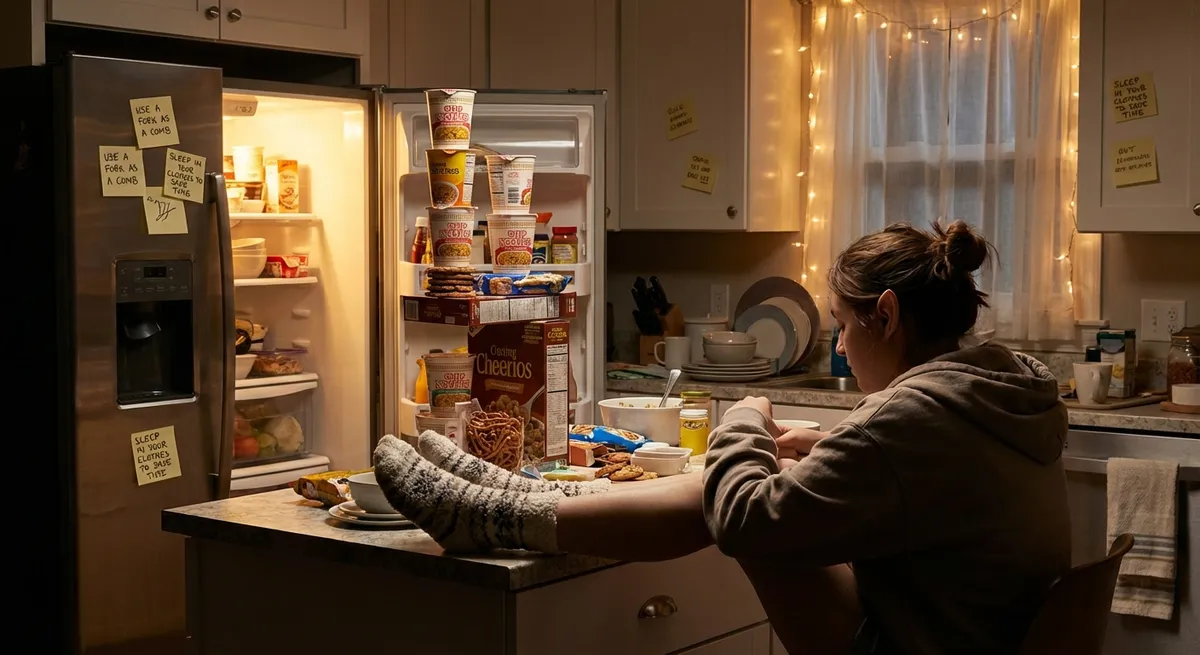
Prep them because Future You is about to open the fridge like a raccoon looking into a treasure chest.
Do it because Future You loves waking up to 100% battery and 0% chaos.
The mental trick: talk about Future You like a celebrity roommate you’re low-key trying to impress.
“Can’t leave this mess, Future Me’s coming home later and they’re a 10/10.”
It turns boring tasks into tiny acts of fan service for your own life.
This is backed by psychology: research on “future self continuity” shows that when we see our future self as a real person, we make better decisions for them—like saving money or choosing healthy behaviors—without feeling as forced.
2. The Gremlin Basket: Stop Pretending You’ll “Put It Away Properly”
Reality check: most of us do not “put things away.”
We “move the pile to a different location and hope it becomes Someone Else’s Problem.”
Enter: The Gremlin Basket.
Rules:
- Get 1–2 big baskets/boxes.
- Put them where the chaos naturally spawns (bedroom floor, by the couch, that cursed chair).
- When items appear where they shouldn’t (random chargers, socks, mail, feral T‑shirts), don’t “put them away.”
Just yeet them into the Gremlin Basket.
Then: pick one day a week (or a day-ish, time is fake) to sit with a podcast and sort the whole basket in one go.
Why it weirdly works:
- Your space looks 70% less cursed with almost zero effort.
- Your brain only has to remember one place where lost stuff might be.
- You cut down “micro-decisions” like “where does this even go?” that secretly drain your energy.
Is this Pinterest-perfect? Absolutely not.
Is it “my room looks vaguely like an adult lives here” perfect? Yes. And that’s the bar now.
3. The One‑Minute Energy Audit (So You Stop Fighting Your Own Brain)
If every day feels like you’re fighting your brain with pool noodles, try this:
Instead of forcing “morning routines” and “night routines,” build a you routine around when your brain is actually semi-functional.
Do a tiny, chaotic one‑minute energy audit:
- For 1–3 days, whenever you remember, rate your energy from 1–10 on your phone’s notes app and write what you’re doing.
- 9/10 – scrolling memes at 11:30 p.m.
- 3/10 – staring at Zoom screen at 2:15 p.m.
- 7/10 – weirdly productive at 9:45 a.m. after coffee.
- If your brain is mush at 2 p.m., why are you scheduling deep work then?
- If you come alive at 9 p.m., maybe that’s “creative hour,” not “doomscroll till eyes hurt” hour.
- Schedule low‑brain tasks (emails, folding laundry, shallow admin) during low‑energy times.
- Put even tiny bits of important stuff (studying, creative work, planning) in your natural high‑energy windows—even if only 10–15 minutes.
After a few days, patterns appear:
Then adjust:
You’re not lazy; you’re just trying to do boss‑level tasks on tutorial‑mode energy.
Backing: circadian rhythms and “chronotypes” (morning vs. evening people) are real. Working with your natural rhythm instead of against it can improve focus, mood, and performance—without you suddenly becoming a 5 a.m. motivational quote.
4. The “Minimum Viable Effort” Spell (Killing All‑Or‑Nothing Thinking)
Your brain loves drama.
It says: “If we can’t do a full 45‑minute workout with a foam roller and a playlist, we should do absolutely nothing and rot.”
Counterspell: Minimum Viable Effort (MVE).
The rule:
- For anything important but annoying (exercise, studying, cleaning, creative projects), decide the smallest, dumbest version that still “counts.”
- Exercise MVE: 5 squats, 10 pushups against the wall, walk around the block.
- Cleaning MVE: Clear just the sink. Or just the desk. Or just the trash.
- Work MVE: Open the doc. Add one sentence. That’s it.
- Studying MVE: Read one page. Watch 5 minutes of a lecture.
If that’s all you do, you win. Gold star. Done.
What usually happens though: once you start, your brain goes “well we’re already here” and you accidentally do 10–20 minutes. That’s the physics of starting: inertia is hardest at the beginning.
Bonus twist:
Track streaks of “Did I do my Minimum Viable Effort?” instead of “Did I do a full perfect session?”
Suddenly, your life is a game of keeping a streak alive, not chasing an imaginary A+.
5. Social Gremlin Mode: Outsourcing Your Self-Control
You know who’s shockingly powerful?
Slightly disappointed friends.
You don’t need “accountability partners” with shared Google Docs and weekly check-ins (unless you’re into that).
You just need one person who will clown you a little if you bail.
Examples:
- Text a friend: “If I don’t send you a pic of my cleaned sink by 9 p.m., you’re allowed to reply with one (1) roast.”
- Tell a coworker: “I’m writing 300 words by lunch. Ask me at 1 p.m. if I did it. If not, I owe you coffee.”
- DM a friend: “I’m allowed to scroll TikTok again once I’ve walked around the block. Time me.”
- Humans hate social embarrassment more than we hate chores.
- The task stops being “I should clean” and becomes “I want to avoid being called a sentient laundry pile.”
- It makes boring tasks feel like mini‑dares, which is apparently what our goblin brains are here for.
- Be that chaotic accountability buddy for someone else.
- Make it fun: send them victory emojis, memes, or weird reaction GIFs when they succeed.
Why this works:
You can even flip it:
Tiny hit of social pressure + tiny hit of social reward = your brain finally takes the hint.
Conclusion
You don’t need a new personality, a $60 planner, or a 4 a.m. alarm.
You need goblin‑compatible systems that assume:
- Your energy is weird,
- Your motivation is flaky,
- And your brain would rather be scrolling.
Treat Future You like a hot celebrity roommate.
Shove the chaos into Gremlin Baskets.
Work with your energy, not against it.
Do the Minimum Viable Effort.
Weaponize your friends as fun little accountability goblins.
Is this the most elegant self‑help philosophy? Absolutely not.
But it might be the one you actually… use.
Now send this to the one friend whose life is 90% “I’ll do it later” and 10% “oh no, it IS later.”
Sources
- [American Psychological Association – Future Self and Decision Making](https://www.apa.org/news/press/releases/2014/08/future-self) – Overview of research on how seeing your future self as real leads to better choices.
- [Harvard Medical School – Understanding Circadian Rhythms](https://www.health.harvard.edu/staying-healthy/what-is-a-circadian-rhythm) – Explains how our internal clocks affect energy and performance throughout the day.
- [University of Chicago – The Power of Small Habits](https://news.uchicago.edu/story/power-habits-and-small-changes) – Discusses how tiny, consistent actions can lead to meaningful behavior change.
- [National Institute of Mental Health – Stress and Mental Health](https://www.nimh.nih.gov/health/publications/stress) – Background on how stress and decision overload affect our brains and daily functioning.
- [Mayo Clinic – Social Support and Health](https://www.mayoclinic.org/healthy-lifestyle/stress-management/in-depth/social-support/art-20044445) – Covers how social support and accountability can improve health and help people reach their goals.